
Thickness Control with Spacer Tapes: Improving Precision in Electronic and Optical Assemblies
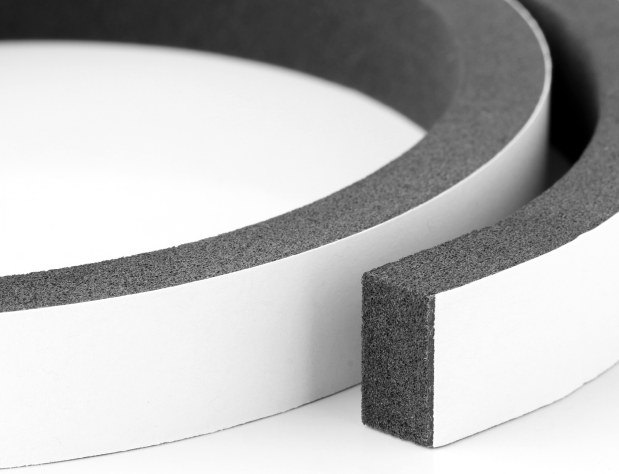
Precision starts with controlling the space between joined surfaces. Bond-line thickness is the gap an adhesive layer fills between two joined surfaces, or substrates, and is a key factor in adhesive assembly. Assembly pressure and other process variables can affect the final adhesive gap, making controlled spacing an important consideration during assembly.
Spacer materials maintain physical separation between substrates, helping preserve the intended geometry of assembled components. In electronic, optical, and micro-electro-mechanical systems (MEMS) assemblies, controlled spacing can be integral to the overall design. The spacer’s material, thickness, and construction are important specification factors.
How Spacer Tapes Control Bond-Line Thickness
The Carrier Establishes Thickness
A spacer tape typically combines an adhesive system with a carrier of a defined thickness. The carrier provides the structural foundation and contributes to the tape’s nominal thickness. The adhesive layers and overall construction also affect the finished tape thickness and the applied gap. These factors determine how the spacer tape achieves the intended separation between substrates.
Spacer constructions are available with various carrier materials and thicknesses, allowing them to be matched to application requirements. Selecting the appropriate carrier is an important part of material selection. For elastomeric foam carriers, account for compression force deflection (CFD) and related foam properties. CFD describes the compressive stress required to deflect the foam by a specified percentage, commonly 25%. Because CFD varies by material grade and test conditions, values should be compared at equivalent deflection levels and test conditions.
For compressible spacer materials, nominal thickness should not be assumed to equal the installed gap. Final spacing also depends on material thickness tolerance, compression under assembly load, and substrate flatness.
Compression and Assembly Pressure
Assembly pressure can affect adhesive thickness by applying force to the adhesive layer during assembly. Without a mechanism to control the gap, that force can displace adhesive and cause the bond-line thickness to vary. A physical spacer provides a defined gap between substrates. Bond-line control depends on both the spacer's physical construction and the forces applied during assembly. Assembly pressure must be sufficient to develop adhesive contact without excessively compressing the spacer and reducing the intended gap.
How Thickness Control Improves Precision in Electronic and Optical Assemblies
Electronic Assemblies
The spacer helps establish the bond line and provides a physical reference for the separation between components. Controlling bond-line thickness helps maintain a consistent dimensional relationship between components. In display technologies and human-machine interfaces (HMIs), such as touchscreens and control panels, a display gasket or foam spacer can frame the display module and help maintain the gap between the cover and the display.
Optical and Micro-Electro-Mechanical Systems (MEMS) Assemblies
Bond-gap structures can control the bond-line thickness between joined surfaces and help manage spacing variation between assembled components. In one optical MEMS application, polyimide spacers bonded mirror and electrode chips in a 1,296-mirror array. The spacers provided large gaps with measured height uniformity within ±1%.
Physical Spacers Are a Design Specification
Without a defined spacer, factors such as substrate flatness and assembly force can affect the final gap. A spacer provides a physical reference for the intended separation between substrates, offering greater control over bond-line thickness and the dimensional relationship between the assembled components. For compressible spacers, long-term gap stability can also be affected by compression set and sustained loading, particularly when the assembly remains under compression during service.
Tape & Foam Options for Spacer Applications
Single-sided foam tapes feature a pressure-sensitive adhesive (PSA) on one side of a foam carrier. Foam types, densities, and thicknesses can vary to meet specific application needs, and several PSA options are available. Materials include polyethylene (PE foam), PVC, rubber, polyurethane (PU foam), silicone foam, and silicone sponge.
Double-sided foam tapes use pressure-sensitive adhesive on both sides of a foam carrier and include a removable release liner. Foam types, densities, and thicknesses vary to meet specific application needs, and several PSA options are available. Materials include polyethylene, polyurethane, and PVC foam.
Acrylic foam tapes are double-sided tapes designed for permanent bonding. They use acrylic foam cores with pressure-sensitive adhesive on both sides, with options ranging from firm to highly conformable. Tapes in the 3M™ VHB™ series are high bond tapes offering different levels of adhesion and conformability.
Single-sided specialty tapes offer thin, engineered backing options for spacer applications. Polyester (PET) and polyimide tapes are available in various thicknesses with acrylic, rubber, or silicone PSAs, while glass cloth tapes provide a solution for applications requiring high tensile strength.
Some thermal insulation materials can also serve as spacers when an assembly requires physical separation alongside thermal or electrical insulation. Thermal fiberglass paper offers excellent thickness control and is used for high-temperature precision gasket insulation. Ceramic fiber paper is thin and flexible, providing good dielectric strength for applications requiring electrical insulation.
Electrical insulation materials can serve as thin barriers or spacers in assemblies requiring electrical separation. Fish paper and aramid fiber paper (Nomex) provide dielectric strength, temperature resistance, and electrical insulation, while polypropylene sheet (Formex) provides dielectric strength and moisture-absorption resistance. Electrical insulation films such as Mylar®, Kapton®, and Teflon™ provide high dielectric strength, with thermal resistance varying by film.
What Engineers Should Specify
Define the required gap size, nominal material thickness, allowable installed-gap range, part shape, and manufacturing tolerances.
Evaluate compression force deflection at the intended compression level and compression set when long-term gap retention is critical. For critical assemblies, verify the installed gap under representative assembly conditions rather than relying on nominal material thickness alone.
Environmental Resistance: Assess exposure to extreme temperatures, UV/ozone, fluids, chemicals, and outdoor weathering.
Compliance & Safety: For vacuum-sensitive applications, consider ASTM E595 outgassing data, including total mass loss (TML) and collected volatile condensable materials (CVCM), and confirm the applicable acceptance criteria.
Engineered Materials offers different foam types, densities, thicknesses, and PSA options, allowing you to match material construction to application requirements.
From Material Selection to Fabricated Part
Once the material and thickness are established, you may need to convert the material into the form required by the assembly. Engineered Materials in-house converting capabilities include the following:
For precision spacer parts, converted-part tolerances should be considered separately from the raw material’s thickness tolerance.
Commonly Asked Questions
What is spacer tape?
Spacer tape is an adhesive tape used to create and maintain a defined gap between two surfaces during assembly. It commonly uses a foam carrier with pressure-sensitive adhesive on one or both sides, making many spacer tapes a form of double-sided adhesive tape.
How does spacer tape control bond-line thickness?
The tape's carrier establishes a nominal thickness between two substrates, while the final bond-line thickness depends on the carrier's compression characteristics and the assembly forces. During assembly, the carrier helps maintain separation between the substrates as the adhesive forms the bond.
How does controlled bond-line thickness improve assembly precision?
A defined spacer establishes a consistent physical reference between substrates. This helps control the dimensional relationship between joined components in assemblies where the gap and component positioning are important design considerations.
Precision Starts With Material Specification
Controlled spacing begins with establishing the required bond-line thickness. Spacer tapes use a physical carrier to maintain separation between substrates, providing a defined dimensional reference within the assembly.
Material type, thickness, adhesive, and construction all contribute to the specification. Foam tapes and closed-cell foam are available in multiple materials, thicknesses, and adhesive options, allowing the selected construction to meet the application's requirements. Converting capabilities transform selected materials into application-specific components.
Need help specifying a spacer solution? Connect with Engineered Materials to discuss material selection, thickness, adhesive, and converting requirements for your application.