
Conductive Tape for EMI/RFI Shielding at High Frequencies

Understanding EMI Shielding in High-Frequency Applications
Electromagnetic interference (EMI) is unwanted electromagnetic energy that disrupts an electronic signal. The source can be another device or a noisy component within the same device, and the energy can propagate as current through conductors or as fields radiated through the air. Radio frequency interference (RFI) is the subset of EMI that falls within the radio frequency range.
Every interference problem forms a chain with three links: a source that conducts or radiates energy, a path the energy travels along, and a susceptible receiving device. The resulting interference can jam or distort communication signals, cause power fluctuations, degrade or even disable electronic circuits, and, in some cases, create a shock or ignition hazard.
Engineers can break the chain at any link. They can suppress noise at the source with filtering or decoupling capacitors, or harden the receiver against what gets through. Shielding breaks the middle link, the path, by using conductive or absorptive materials to reflect, redirect, or absorb electromagnetic energy before it reaches the susceptible receiver.
Conductivity is one factor in material selection. Shielding effectiveness also depends on how the shield is constructed, its thickness, how it’s installed, and how well it contacts adjacent components.
Conductive Foils and Tapes: Establishing Shielding Barriers
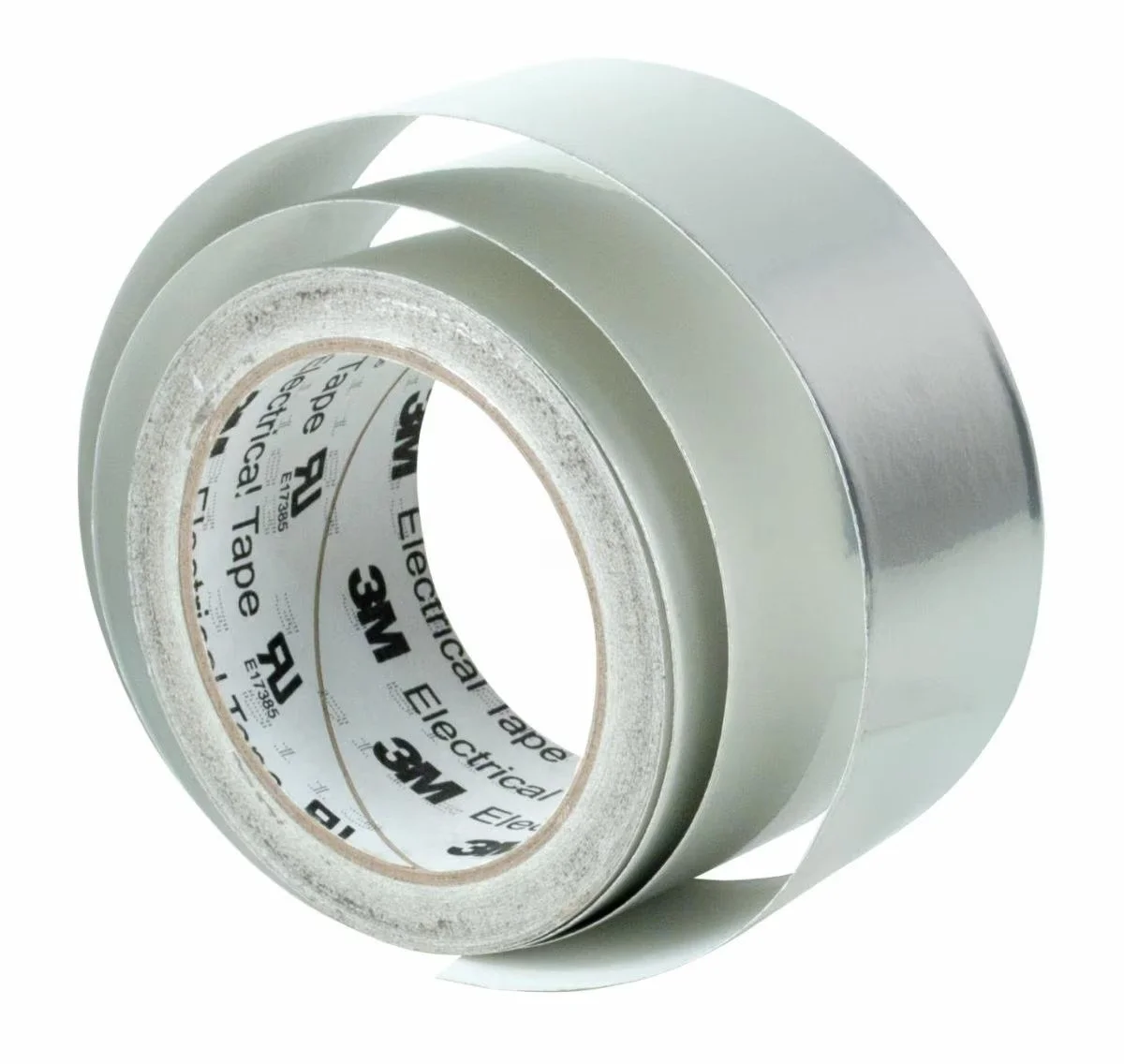
Copper and aluminum foil tapes feature a metallic backing and a pressure-sensitive adhesive, providing a conductive surface for cable wrapping, enclosure seams, and grounding. Metals remain widely used for shielding because of their high electrical conductivity and strong reflection-based performance, although actual shielding effectiveness depends on frequency, material thickness, seams, apertures, and electrical continuity across the finished assembly. The trade-off is weight, cost, and corrosion susceptibility, so lighter metal-coated alternatives offer somewhat lower performance (60 to 90 dB).
Copper is the most conductive metal after silver. Copper foil can also be soldered, so separate lengths can be joined into one continuous shield. Tin-plated copper adds resistance to oxidation and corrosion while remaining solderable. Aluminum is about 40% less conductive than copper but offers a lower-cost alternative. Adhesive selection is equally important. Standard acrylic adhesive is an insulator, so electrical contact depends on the metal backing touching a component at the edge. Conductive adhesives provide an electrical path through the bond line, allowing the foil backing to make electrical contact with a conductive substrate when adequate surface contact is established.
Products built for this type of application include Saint-Gobain CHR C661 and C665, along with 3M 1181, 1183, and 1345 shielding tapes. 3M 1345 features an embossed copper foil backing with raised edges that physically cut through the adhesive layer, creating direct metal-to-metal contact with the substrate instead of relying on conductive particles in the adhesive.
Dielectric and Insulation Materials Used Alongside Shielding
Shielding is usually paired with dielectric materials that provide insulation, preventing electrical shorts and grounding issues when a conductive shield is near other components.
Fish paper (vulcanized fiber) is well known for its high tensile strength. Multi-ply kraft paper is an economical alternative that offers very high tear resistance to withstand rugged handling, but its tensile strength is significantly lower than that of fish paper.
Nomex, an aramid fiber paper, offers high dielectric strength and chemical and flame resistance (UL 94 VTM-0 and V-0 rated). Its electrical and mechanical properties remain essentially unaffected up to 200°C (392°F), and it is rated for continuous use at 220°C (428°F) for at least 10 years.
Formex, a flame-retardant (FR) polypropylene, carries a UL 94 V-0 flame rating (VTM-0 in thinner gauges) and has just 0.06% water absorption while remaining foldable and scoreable without cracking.
Electrical insulation films: Mylar (PET) balances chemical, thermal, and electrical resistance; Kapton (polyimide) performs over a wide temperature range; Teflon offers strong resistance to thermal, chemical, and environmental factors.
Fabric-Over-Foam Gaskets: Maintaining Contact Across Gaps
Fabric-over-foam gaskets combine a conductive textile exterior with a compressible foam core. The fabric maintains electrical contact across mating surfaces, while the foam accommodates enclosure tolerances. Common applications include cabinet doors, panel seams, covers, and connector interfaces. Compression, compression set, and gasket geometry affect whether sufficient contact pressure and electrical continuity are maintained across the interface over the product’s service life.
The trade-off: Unlike solid conductive elastomers, standard fabric-over-foam gaskets provide limited sealing against liquids and corrosive outdoor environments unless they are treated or laminated with a secondary moisture barrier.
EMI-Absorbing Materials: Addressing Localized Interference
While traditional conductive shielding primarily reflects or redirects electromagnetic energy, absorptive materials are optimized to capture and dissipate it as heat within the material. Absorptive materials can be useful when reflected energy contributes to cavity resonance, coupling, or other localized EMI problems. Cavity resonance, a common EMI issue at the board and enclosure levels, can compromise circuit operation and reduce shielding effectiveness.
Magnetically loaded elastomers are flexible sheets filled with magnetic particles that dissipate energy via magnetic loss. These sheets can also suppress near-field noise coupling between printed circuit board (PCB) components. Carbon-loaded foams rely on dielectric loss and are suited to higher-frequency, free-space applications such as antenna isolation. Because each formulation operates within a specific frequency range, absorber selection begins with the operating band.
Shielding Laminates and Converting Capabilities
Laminates combine two or more materials to provide conductivity, adhesion, flexibility, insulation, or mechanical support in a single construction tailored to a specific application. Multi-layer lamination, slitting, and die-cutting capabilities enable these custom applications to scale.
Designing for Electrical Continuity and Shielding Effectiveness
Shielding effectiveness is expressed in decibels (dB) and represents the reduction in electromagnetic field strength or power achieved with the shield in place compared with the unshielded condition. Shielding effectiveness varies with frequency, and at higher frequencies, seams, apertures, and discontinuities in electrical contact can become increasingly important to overall shielding performance.
Because EMI/RFI shielding is common in medical, military, and aerospace applications, several standards govern testing:
ASTM D4935: measures the shielding effectiveness of planar materials using a coaxial transmission-line test method. Results characterize the material or material construction under the specified test conditions and should not be treated as the shielding effectiveness of the finished enclosure.
MIL-DTL-83528: the governing U.S. DoD detail specification for electrically conductive elastomeric shielding gasket materials
IEEE 299: provides methods for measuring the shielding effectiveness of electromagnetic shielding enclosures and structures.
Frequently Asked Questions
What are electrically conductive tapes used for?
Electrically conductive tapes are designed for EMI shielding and grounding, helping products meet electromagnetic compatibility requirements across consumer electronics, automotive, and aerospace applications. Tapes with conductive adhesive provide electrical continuity through the bond line, helping maintain a conductive shielding path across seams, joints, and grounded interfaces.
Can EMI shielding tapes also be used for static charge draining?
Yes. Copper foil tapes, such as 3M 1181, are commonly used for EMI/RFI shielding, static charge dissipation, seaming shielded rooms, cable wrapping, and for making surface contact with non-solderable materials.
What is conductive fabric tape?
Conductive fabric tape uses a metalized woven or nonwoven fabric carrier instead of a metal foil backing. For example, 3M 9711S is a double-sided tape with a nickel/copper-coated woven fabric carrier and conductive adhesive, providing XYZ-axis conductivity. 3M 9750 is a double-sided tape with an electrically conductive nonwoven carrier and conductive acrylic adhesive, it conducts both through its thickness and across its plane. Nickel/copper-plated polyester fabric is also a common conductive outer layer for fabric-over-foam gaskets.
How do conductive tapes contribute to Faraday cage shielding?
A Faraday cage is a conducting enclosure that surrounds a volume and prevents electrical coupling between the inside and the outside. al enclosures are not perfect conductors, so shielding effectiveness depends on maintaining electrical continuity and controlling seams, joints, apertures, and other paths where electromagnetic energy can couple through the enclosure. Conductive tapes help maintain shielding continuity by bridging seams, joints, and cable entries, where gaps would otherwise compromise the enclosure.
From Material Selection to Custom-Fabricated Components
Choosing the right shielding material starts with identifying the interference frequency range, coupling path, and required attenuation, then evaluating the electrical, mechanical, and environmental properties the application requires. From there, construction, thickness, installation, and component contact can all influence shielding effectiveness. The best result brings these considerations together in a fabricated component tailored to your application. Need help selecting the right shielding material or component? Contact Engineered Materials to discuss your requirements.