
How High Temperature Films and Dielectrics Support Electronics in Harsh and Regulated Environments
Managing Heat, Electrical Stress, and Compliance in Electronic Assemblies
Electronics operating in harsh environments face sustained heat, electrical load, vibration, and mechanical stress. In these conditions, insulation materials must do more than withstand temperature. They must preserve dielectric strength, maintain electrical resistance, and protect voltage separation as conditions fluctuate.
In manufacturing environments such as appliance controls, HVAC power modules, transportation electronics, data center cooling systems, and EV charging assemblies, failure typically begins when conventional insulation materials lose dielectric retention under sustained thermal load. This degradation narrows creepage and clearance margins, increases leakage current, and can ultimately result in partial discharge, arcing, or catastrophic short circuits. For the design engineer, failure means warranty exposure, regulatory non-compliance, and potential safety risk.
High-temperature films function primarily as electrical isolation systems. Thermal capability supports that role. As temperature rises, dielectric strength and electrical resistance decline while leakage current increases. The key engineering consideration is how well dielectric properties are retained at operating temperature.
Thermal rating alone (for example, Relative Temperature Index per UL 746B or UL 746C) does not guarantee dielectric performance at voltage stress. Engineers must evaluate dielectric strength per ASTM D149 at elevated temperature and insulation resistance per ASTM D257 to understand real operating margins.
How Temperature Changes Dielectric Performance in Electrical Insulation Systems
In high-voltage or high-frequency assemblies, insulation failure does not always occur as immediate breakdown. Partial discharge (PD), evaluated per IEC 60270, can initiate at voids or interfaces when local electric field intensity exceeds corona inception voltage. Over time, PD erodes polymer chains and reduces dielectric strength.
Surface tracking resistance, often measured using Comparative Tracking Index (CTI) per IEC 60112, becomes critical in humid or contaminated environments. Materials with low CTI are more susceptible to carbonized conductive paths under voltage stress.
For electronics operating above 400–600 V, PD resistance and CTI may govern long-term reliability more than nominal dielectric strength
Dielectric materials resist electrical breakdown and maintain insulation between conductive elements. These properties change as temperature increases.
As polymers are exposed to heat:
Molecular mobility increases
Electrical resistance decreases
Leakage current rises
Dielectric strength declines
Dissipation factor increases
Reduced dielectric strength narrows voltage separation margins. In high voltage assemblies, even incremental changes can affect long-term reliability.For example, a 10–15% reduction in dielectric strength at elevated temperature can reduce safety margin below required creepage distances defined in IEC 60664 or UL 840, particularly in compact PCB assemblies. Thermal rating indicates survivability. Dielectric retention under heat determines electrical performance.
Understanding High-Temperature Films and Dielectric Materials for Electrical Insulation
Polyimide Films
Polyimide films are widely used for high-temperature electrical insulation because they retain dielectric properties under sustained thermal load. Often specified as Kapton® tape constructions, polyimide films provide exceptional heat resistance, chemical stability, and dimensional control in demanding assemblies.
Typical dielectric characteristics include:
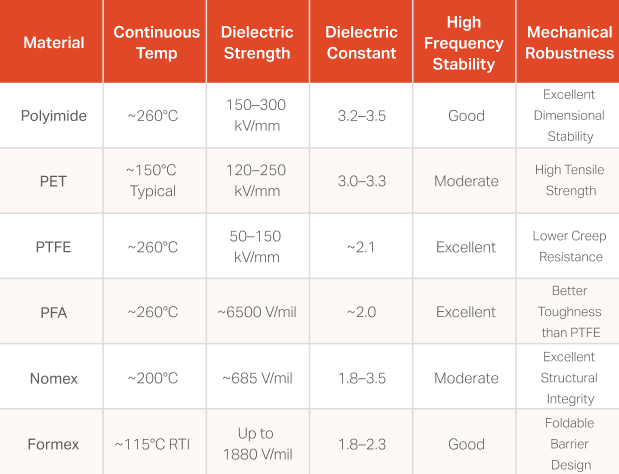
Dielectric strength typically 150–300 kV/mm
Dielectric constant near 3.2–3.5
High electrical resistance across wide temperature ranges
Strong dimensional stability during thermal cycling
Heat stabilized capability up to approximately 260°C (grade dependent)
Polyimide tapes combine a polyimide film backing with pressure-sensitive adhesives such as silicone or acrylic systems. Silicone adhesives are frequently selected for extreme temperature performance, while acrylic systems may support clean processing or low outgassing requirements. Many constructions are UL listed and flame retardant, supporting regulated electrical applications. Many polyimide systems are classified as Class H insulation (180°C) or higher depending on construction.
Silicone PSA systems typically support intermittent exposure up to 260°C (500°F), while acrylic systems often provide continuous performance to 150–180°C (302–356°F) depending on formulation. Adhesive selection directly impacts dielectric integrity under voltage stress and thermal cycling.
Commercial examples include 3M™ and Saint-Gobain polyimide film tapes used for:
Electrical insulation on coils, transformers, capacitors, and wiring harnesses
Printed circuit board solder masking
High-temperature masking
Gold finger protection during wave soldering
Heat shielding and splicing in electronics and automotive systems
Polyimide constructions maintain dielectric strength and dimensional stability across temperature ranges from cryogenic conditions to elevated heat environments, helping preserve creepage and clearance margins in high-voltage assemblies.
PET (Polyester Terephthalate) Films for Electrical Insulation
PET film, or polyethylene terephthalate, provides electrical insulation with strong mechanical properties. Often specified as Mylar® film or in single-sided polyester tape constructions, PET offers a balance of dielectric performance, abrasion resistance, and chemical durability for moderate temperature applications.
Typical dielectric characteristics include:
Dielectric strength: 120–250 kV/mm
Dielectric constant: 3.0–3.3
Strong ultimate tensile strength
Good chemical and solvent resistance
Stable thermal properties within defined operating ranges
Single-sided polyester tapes combine a PET backing with rubber, acrylic, or silicone pressure-sensitive adhesives, enabling performance across service temperature ranges commonly between -60°F and 300–400°F, depending on adhesive system and construction. Many electrical grades can meet UL 510A flame-retardancy requirements.
PET constructions are widely used for:
Wrapping coils, capacitors, wire harnesses, and transformers
Electrical insulation and splicing
High-temperature masking and powder coating
Label and surface protection
Flexible electronics and slit-to-width roll applications
As temperature approaches upper operating limits, dielectric strength and electrical resistance may decline more rapidly than in polyimide. Surface treatments or coating processes may enhance adhesion or barrier protection in laminated constructions, but dielectric retention under operating temperature remains the governing requirement.
PET is frequently selected in automotive and transportation assemblies where materials may be reviewed against FMVSS 302 or OEM-defined safety criteria.
FluoropolymerFilms (FEP, PTFE, PFA) for High-Voltange and High-Frequency Dielectric Applications
Fluorinated ethylene propylene (FEP) film is a fluoropolymer insulation material specified for applications requiring stringent electrical performance and elevated temperature capability. FEP provides excellent electrical insulation, strong thermal stability, best-in-class chemical resistance, and a slick, inert surface. FEP dielectric strength typically ranges from 60–100 kV/mm depending on thickness.
In dielectric systems, FEP film supports:
Stable electrical insulation across wide temperature ranges
Consistent dielectric performance in high voltage assemblies
Reliable barrier protection in laminated constructions
Common applications include electrical insulation, flexible printed circuits, fiber optic cables, high-frequency circuitry, cable insulation, barrier films, and photovoltaic systems.
When incorporated into layered dielectric constructions, FEP film helps maintain voltage separation and long-term insulation reliability in electrically demanding environments.
PTFE (polytetrafluoroethylene), originally known under the Teflon™ brand, is characterized by a low dielectric constant (typically near 2.1), excellent electrical insulation, and best-in-class chemical resistance. It is specified for high-voltage and high-frequency applications where dielectric constant stability and electrical resistance are critical. Dielectric strength for PTFE is commonly measured in the range of 50–150 kV/mm depending on thickness and test method (ASTM D149).
PTFE maintains dielectric performance across wide temperature ranges while also providing:
Excellent chemical and solvent resistance
Low coefficient of friction and non-stick surface properties
Strong thermal stability in demanding environments
In tape constructions, PTFE films are commonly paired with silicone or acrylic pressure-sensitive adhesives. Silicone adhesive systems support elevated temperature performance, while acrylic systems may provide strong adhesion and solvent durability.
Commercial examples include 3M™ and Saint-Gobain CHR® PTFE film tapes used for:
High-voltage insulation and coil wrapping
Transformer and capacitor insulation
Cable splicing and wire harness protection
Heat-sealing equipment and non-stick surface protection
Chute linings and industrial release surfaces
Depending on construction, PTFE tape systems can operate across service temperature ranges from approximately -65°F to 500°F (-54°C to 260°C).
PTFE film constructions support insulation reliability in demanding assemblies.
Perfluoroalkoxy (PFA) film, combines strong dielectric performance with improved mechanical durability compared to PTFE while maintaining similar chemical inertness.
Typical dielectric and thermal performance includes:
Dielectric strength approximately 6500 V/mil
Dielectric constant near 2.0 (1 kHz, 77°F)
Volume resistivity > 1 × 10¹⁷ ohm·cm
Dissipation factor typically 2.0–7.0 × 10⁻³
Melt point approximately 310°C
Operating temperature range approximately -400°F to 500°F
UL 94 V-0 flammability rating
Volume resistivity is typically measured per ASTM D257, and dissipation factor per ASTM D150
The low dielectric constant supports stable signal transmission and voltage separation in high-frequency and high-voltage assemblies, while high volume resistivity preserves electrical resistance under sustained thermal exposure.
Compared to PTFE, PFA offers improved mechanical toughness and processability, making it well suited for laminated dielectric constructions, barrier films, cable insulation, flexible printed circuits, and photovoltaic back sheets.
Nomex Aramid Paper for High-Temperature Electrical Insulation
Nomex is an aramid fiber paper used for electrical insulation in motors, transformers, generators, and other high-temperature electrical systems. It is widely regarded as a benchmark insulation material due to its combination of dielectric strength, thermal stability, and mechanical durability.
Typical performance (grade dependent) includes:
Dielectric strength up to 685 V/mil
Dielectric constant 1.8–3.5 @ 60 Hz
Relative Temperature Index (UL 746B) 428°F (220°C)
Continuous operating capability up to approximately 200°C
UL 94 VTM-0 / V-0 flammability ratings
Nomex retains dielectric strength and electrical resistance under sustained thermal load, helping preserve voltage separation margins in high-voltage assemblies. Nomex is frequently evaluated within UL recognized insulation systems and is commonly used in Class 180 (H) and Class 200 (N) motor insulation systems. Available in paper roll and pressboard sheet formats, it is commonly converted into slot liners, coil separators, and other precision insulation components for regulated electrical environments.
Formex Polypropylene Dielectric Barrier Material
Formex is a flame-retardant polypropylene dielectric barrier material designed to electrically isolate components, shield against electrical surges, and prevent arcing. It functions as both a thermal and electrical barrier in voltage-sensitive assemblies.
Typical performance (grade dependent) includes:
Dielectric strength up to 1880 V/mil
Dielectric constant 1.8–2.3 @ 1 MHz
Relative Temperature Index (UL 746C) 239°F (115°C)
Ultra-low moisture absorption <0.6%
UL 94 VTM-0 / V-0 flame ratings
Formex maintains dielectric strength and electrical resistance while offering strong dimensional stability and chemical resistance. Its folding and scoring capability allows conversion into precision barriers, air baffles, and wire management components. Formex is commonly specified for surge protection barriers and evaluated for spacing compliance per UL 60950-1 and IEC 62368 in IT and power supply equipment. It is widely used in EV onboard chargers, PC board barriers, and data center control systems, and is frequently incorporated into laminated dielectric constructions to maintain surge protection and voltage separation.
Material Selection Matrix for High Temperature Electrical Insulation
Engineers evaluating high-temperature electrical insulation materials should balance four primary variables:
Temperature Class
Voltage Stress
Frequency Range
Mechanical and Chemical Exposure
Why High-Temperature Insulation Matters
Elevated temperatures accelerate polymer degradation, reducing dielectric strength and electrical resistance while increasing the risk of arcing, short circuits, and signal interference.
Stable insulation systems preserve voltage separation and reliability under thermal and mechanical stress while supporting safety and compliance.
Common Applications for High-Temperature Films and Dielectrics
Electronics and Electrical Assemblies
Circuit board and component insulation
Electrical isolation between conductive elements
Flexible electronics and precision die cut insulation parts
Electrical insulation in high-heat, high-vibration environments
Lightweight dielectric barriers for aircraft and mobility systems
Materials may be evaluated relative to FAR 25.853 in aerospace and FMVSS 302 or OEM-defined criteria in automotive applications. While these standards address flammability, dielectric retention at operating temperature determines electrical safety.
Industrial Equipment and Automation
Motors, sensors, power supplies, and control systems
Electrically stressed assemblies exposed to sustained heat or chemicals
Performance and Compliance Considerations for High-Temperature Insulation
When evaluating high-temperature dielectric materials, engineers should assess:
Operating temperature range and thermal properties
Dielectric strength at operating temperature
Dielectric constant stability under heat
Electrical resistance under sustained voltage
Mechanical strength and dimensional stability
Environmental exposure including heat, vibration, and chemicals
Fire-retardant performance expectations
Electrical or electromagnetic shielding needs
Compatibility with converting, assembly, and manufacturing processes
Additional failure modes to evaluate include adhesive creep at elevated temperature, liner shrinkage during thermal cycling, edge lifting in laminated constructions, and coefficient of thermal expansion (CTE) mismatch between dielectric layers and metal substrates. Thermal capability enables service life. Dielectric retention under temperature determines electrical reliability.
Converting High-Temperature Films for Application Fit
Precision Cutting for Electrical Insulation Components
Rotary die cutting for high-volume, repeatable insulation geometries
Traveling head die cutting for thicker or more rigid materials
Inline precision flatbed die cutting for tight tolerances and complex profiles
Wide-format die cutting for large components and sheet-based applications
Knife and digital cutting for prototyping and intricate, low-volume designs
Die cut parts maintain consistent spacing in voltage-sensitive assemblies.
Sheeting and Slit to Width Rolls for Electrical Insulation
Custom slit-to-width rolls for insulation layers
Clean, consistent edges to support automated or manual assembly
Edge quality is critical to prevent fiber shedding or dielectric discontinuity in high-voltage wrap applications.
Adhesive Lamination and Mulit-Layer Dielectric Constructions
Adhesive lamination with pressure-sensitive adhesives
Multi-layer dielectric and insulation constructions
Application-ready components to simplify installation and reduce handling risk
Proper lamination and curing process control help preserve dimensional stability and dielectric integrity across the finished assembly.
Wide-web lamination (up to 60 inches) allows integration of dielectric films, barrier layers, and pressure-sensitive adhesives into application-ready components. Process control of nip pressure, dwell time, and adhesive selection directly influences long-term dielectric retention. Pressure-sensitive adhesive (PSA) layers also contribute to dielectric performance. In thin-film insulation stacks, adhesive thickness can meaningfully affect overall breakdown voltage. Engineers should evaluate complete laminate construction rather than film-only data sheets.
Industries That Rely on High-Temperature Films and Dielectrics
Electronics and Electrical Manufacturing
Aerospace, automotive, and transportation system
Industrial automation and equipment
Selecting the Right Insulation Solution
To select an effective dielectric system:
Match material properties to thermal and electrical requirements
Evaluate environmental conditions and applicable safety standards
Prototype and validate insulation performance at operating temperature
Align material selection with converting capabilities and production requirements
How High-Temperature Films and Dielectrics Support Reliable Electrical Insulation Performance
Polyimide, PET, fluoropolymers, Nomex, and Formex protect electronics in harsh and regulated environments by maintaining dielectric strength, dimensional stability, and barrier integrity under sustained stress.
Selecting the correct dielectric system requires aligning operating temperature, voltage stress, environmental exposure, regulatory requirements, and converting constraints into a validated insulation strategy. Engineered material selection supports performance, safety alignment, and long-term reliability.Precision converting enables application-specific insulation solutions across demanding use cases.
Connect with Engineered Materials for High Temperature Electrical Insulation Solutions
Connect with Engineered Materials to discuss high-temperature film and dielectric solutions engineered to support your electronic insulation, performance, and compliance requirements.