
Acrylic vs. Silicone vs. Rubber Pressure-Sensitive Adhesives in Demanding Applications

Thermal Stress Failure Mechanisms in Pressure-Sensitive Adhesive Bonded Assemblies
Bonded assemblies in industrial, electronic, transportation, and aerospace environments experience sustained heat, thermal cycling, and mechanical movement. Failure in conventional adhesive systems under these conditions typically presents as creep deformation, edge lift, adhesive softening, cohesive split within the adhesive layer, or interfacial failure at the substrate interface. In regulated industries, these failures can result in electrical insulation loss, moisture intrusion, NVH degradation, or non-compliance with fire and flammability standards — all of which carry warranty, safety, and liability implications for the design engineer. In these conditions, a pressure sensitive adhesive must maintain bond strength not only at room temperature but across the full-service envelope of the assembly.
PSA performance is influenced by:
Temperature magnitude
Exposure duration
Rate of temperature change
These variables affect the viscoelastic polymer structure of the adhesive. As temperature increases, molecular mobility rises and modulus decreases. Under sustained load, this reduces shear strength and increases creep. Under cyclic temperature exposure, differential expansion between bonded materials can introduce peel stresses at bond edges. This effect is amplified when substrates exhibit significantly different coefficients of thermal expansion (CTE), such as aluminum (~23 µm/m°C) bonded to polycarbonate (~65–70 µm/m°C), creating repeated edge stress during cycling.
In regulated applications, adhesive selection is influenced by thermal performance, long-term durability, and applicable safety or flammability standards. Transportation interior materials may be evaluated under FMVSS 302. Aerospace interior materials may be evaluated under FAR 25.853. Electrical insulation assemblies may also require UL 94 flammability or UL 746C weathering evaluation depending on end use.
Understanding PSA behavior under heat reduces bond failure risk and improves long-term reliability.
Thermal Stress in Bonded Assemblies: Sustained Heat vs. Thermal Cycling
Sustained elevated temperature reduces adhesive modulus and increases susceptibility to creep under static shear load. Shear creep is commonly evaluated using ASTM D3654, where load is applied at elevated temperature to quantify time-to-failure under constant stress. Thermal cycling causes repeated expansion and contraction of substrate materials. When bonded substrates have different coefficients of thermal expansion (CTE), stress concentrates at the bondline, especially at free edges. Peel-dominated stress at bond edges often becomes the governing failure mode even when bulk shear strength remains high.
Viscoelastic Behavior at Elevated Temperatures
Pressure-sensitive adhesives exhibit viscoelastic behavior, combining elastic recovery and viscous flow. As temperature rises, viscous response dominates.
This affects:
Shear strength
Peel adhesion
Long-term bond strength
The glass transition temperature (Tg) of a pressure-sensitive adhesive marks the transition from a glassy, rigid polymer state to a rubbery viscoelastic state. Acrylic PSAs typically exhibit Tg values between –20°C and –50°C depending on formulation, while silicone PSAs may exhibit Tg values below –100°C. When service temperature approaches Tg + 50°C to 80°C, modulus reduction accelerates and creep potential increases. Understanding Tg relative to service temperature is critical for predicting long-term shear performance.
At elevated temperatures approaching the adhesive glass transition temperature (Tg), modulus reduction accelerates, increasing risk of creep and adhesive flow. Bondline thickness also influences performance—thicker bondlines generally improve stress accommodation but may increase creep potential under sustained load.
Time-at-Temperature Impacts on Durability
Short-term exposure to elevated temperature may not immediately reduce bond integrity. However, prolonged exposure under mechanical load often governs durability. Time–temperature superposition principles are frequently used in adhesive design to predict long-term creep performance. Extended dwell at elevated temperature can permanently alter polymer structure, reducing cohesive strength.
Common Failure Modes
Common failure modes under thermal stress include:
Creep under sustained load
Shear loss at elevated temperature
Adhesive softening
Cohesive failure within the adhesive layer
Interfacial failure due to poor wet-out on low surface energy substrates
Edge lift initiated by thermal cycling
Joint geometry strongly influences thermal performance. Lap shear joints distribute stress more uniformly than peel-loaded joints. Peel stress concentrates at bond edges and becomes the governing failure mode during thermal cycling. Increasing bond area, reducing free edges, and specifying adequate adhesive thickness (e.g., 5–10 mil transfer tape vs. 2 mil thin bond) can improve stress distribution and reduce creep-driven edge lift.
PSA Chemistries Used in Thermally Demanding Applications
Common chemistries include:
Acrylic pressure-sensitive adhesives
Silicone pressure-sensitive adhesives
Rubber-resin PSAs, including natural and synthetic rubber-based systems
Each chemistry responds differently to heat, thermal cycling, UV exposure, humidity, and substrate surface energy.
Chemistry selection affects:
Adhesion retention
Movement accommodation
Long-term durability
Alignment with safety and regulatory requirements
Material selection must match environmental exposure, load profile, substrate material, and regulatory expectations.
Rubber-Resin Pressure-Sensitive Adhesives for Moderate Temperature and High Initial Tack Applications
Rubber-resin pressure-sensitive adhesives (PSAs), including natural rubber and synthetic rubber systems, are engineered for aggressive initial tack and rapid wet-out on a wide range of substrates. Their fast bond build makes them attractive in high-speed manufacturing environments and applications where immediate handling strength is required.
Rubber-resin PSAs typically support continuous service temperatures up to approximately 150°F (65°C), depending on adhesive thickness and applied load. Short-term exposure may exceed this value, but sustained elevated temperature reduces modulus and accelerates creep under shear stress.
Key attributes include:
High initial tack and quick stick
Strong adhesion to low surface energy (LSE) substrates without surface treatment
Lower material cost relative to acrylic and silicone systems
Rubber-resin PSAs generally exhibit:
Lower long-term heat resistance
Reduced UV durability compared to acrylic systems
Greater susceptibility to creep during prolonged thermal exposure
Because rubber adhesives exhibit lower thermal stability than acrylic or silicone chemistries, shear strength retention declines more rapidly as temperature approahes 150°F (65°C). Elevated temperature accelerates oxidative aging in rubber-resin systems. Plasticizer migration, antioxidant depletion, and polymer backbone degradation can reduce long-term adhesion and cohesive strength. UV exposure may also contribute to surface embrittlement unless protected by backing materials.
Acrylic Pressure-Sensitive Adhesives for Elevated Temperature and Thermal Cycling
Acrylic pressure-sensitive adhesives offer the broadest ability to modify chemistry and construction. They are widely used in automotive industries, appliances, HVAC systems, and industrial equipment requiring durable bond strength.
Balanced Performance Across a Broad Temperature Range
General-purpose acrylic systems commonly support continuous service temperatures between approximately 180°F and 250°F (80°C to 120°C), depending on formulation and load.
High-performance acrylic systems extend temperature capability. 3M 100MP acrylic adhesive constructions support operating temperatures up to 300°F (149°C) and short-term exposure up to 500°F (260°C). acrylic adhesive constructions support operating temperatures up to 300°F (149°C) and short-term exposure up to 500°F (260°C).
Acrylic foam tapes such as 3M VHB GPH series support long-term exposure up to 300°F (149°C) and short-term exposure up to 450°F (230°C).
Acrylic systems provide strong shear strength retention and peel adhesion performance with good resistance to UV exposure and environmental aging.
Performance is influenced by:
Service temperature
Exposure duration
Bond-line thickness
Substrate surface energy
Applied mechanical load
FMVSS and Industrial Applications
Acrylic PSAs are frequently used in transportation and industrial assemblies where materials are selected with reference to FMVSS 302 or OEM-defined safety criteria.
Temperature Performance by Category – Thin Bond PSAs
Thin bond adhesive transfer tapes represent a major acrylic category.
General-purpose acrylics support moderate temperature environments typically up to 200°F for long term exposure.
High-performance acrylics Double-sided tapes extend shear strength and environmental resistance. Long term temperature resistances can reach up to 250°F
High-temperature acrylic systems, including 3M 100MP families, are engineered for elevated heat exposure of up to 300°F in long term exposure.
These systems are commonly specified in membrane switches, nameplates, thin metal laminations, and other precision assemblies.
GPH VHB Acrylic Foam Tapes
Acrylic foam tapes combine a viscoelastic foam core with durable acrylic adhesive chemistry. The foam core distributes stress across the bond-line and improves accommodation of differential thermal expansion during cycling. 3M™ VHB™ GPH Series tape provides excellent high temperature performance up to 450 °F and allows for bonding prior to powder coat processes. It also provides consistent low temperature bonding at application temperatures above 50 °F.
Low Surface Energy (LSE) Acrylics
LSE acrylic systems improve wet-out and adhesion to low-energy surfaces such as polyethylene and polypropylene. Improved substrate surface energy compatibility enhances mechanical interlocking and bond strength retention under heat.
Silicone Pressure-Sensitive Adhesive
Silicone pressure-sensitive adhesives are designed for sustained high and extreme temperature exposure.
High-Temperature Resistance
Silicone PSAs commonly support continuous service temperatures between approximately 350°F and 400°F (177°C to 204°C), depending on formulation.
Specialized polyimide-backed silicone constructions support continuous exposure up to 500°F (260°C).
Performance Characteristics
Silicone pressure-sensitive adhesives maintain flexibility and adhesion at temperatures beyond the practical limits of many acrylic systems. They bond effectively to many low surface energy and silicone rubber substrates and maintain performance under elevated thermal stress. They also exhibit low glass transition temperatures, maintaining flexibility at sub-zero conditions down to approximately –65°F (–54°C) depending on formulation.
Trade-Offs
Silicone adhesives may exhibit lower adhesion to certain non-silicone substrates compared to acrylic systems. Substrate surface preparation and surface energy evaluation are critical to achieving desired peel strength and bond strength. Cost per square foot is generally higher than acrylic systems, and cohesive strength under sustained shear may be lower in moderate temperature environments.
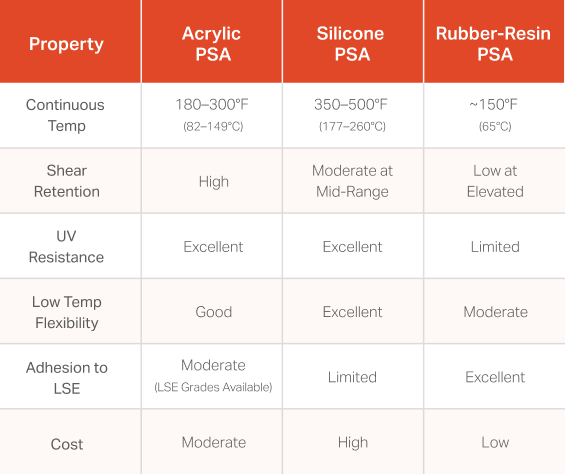
PSA Chemistry Comparison Table
Aerospace and Electronics Applications
Silicone PSAs are commonly specified in aerospace and high-temperature electronics applications. Assemblies may be evaluated under FAR 25.853 for flammability and thermal stability. Fire-retardant requirements frequently influence material selection.
Rubber-Resin Pressure-Sensitive Adhesives
Rubber-resin PSAs, including natural rubber PSAs, provide high initial tack and rapid wet-out.
Temperature and Durability Limits
Typical continuous service temperatures are approximately 150°F (65°C), depending on formulation and load conditions. Elevated temperature accelerates adhesive softening and reduces shear strength retention under sustained load. Oxidative aging and plasticizer migration can further reduce long-term adhesion in high-heat environments.
Best-Fit Applications
Rubber-resin PSAs are best suited for:
· Lower temperature environments
· Short-duration exposure
· Non-critical or unregulated applications
They provide strong initial tack and peel adhesion but offer limited resistance to sustained heat and thermal cycling compared to acrylic and silicone systems.
PSA Performance Under Thermal Cycling
Under repeated expansion and contraction:
· Acrylic systems balance durability and temperature resistance
· Silicone systems excel in extreme heat with substrate compatibility trade-offs
· Rubber PSAs prioritize quick stick with limited thermal tolerance
No single chemistry fits all thermal profiles. Gains in high-temperature resistance often involve trade-offs in adhesion, flexibility, compatibility, or cost.
Reliable performance depends on matching chemistry to temperature profile, movement amplitude, exposure duration, and regulatory expectations.
Testing and Validation of Pressure Sensitive Adhesives Under Thermal Stress
Common evaluation methods include:
· ASTM D3654 for shear strength under load
· ASTM D3330 for peel adhesion
· Creep testing after defined temperature exposure
Additional evaluations may include ASTM D1002 lap shear, UL 94 flammability, UL 746C long-term aging, and environmental conditioning such as 1000-hour heat aging or thermal cycling between defined temperature limits. Internal OEM test protocols may also apply.
Laboratory results must be interpreted in the context of real-world assemblies, including substrate material, bondline thickness, mechanical load, and environmental conditions.
Application-specific validation is critical for reliable performance.
Applications Where PSA Selection Is Critical
Electronics and Electrical Assemblies
Bonding components exposed to internal heat requires adhesives capable of maintaining insulation reliability and bond stability. Electrostatic interactions and EMI/RFI shielding performance may also be influenced by adhesive behavior.
Industrial equipment may experience sustained and fluctuating operating temperatures. Fire-retardant performance expectations may be tied to equipment safety requirements.
Transportation and Automotive
Assemblies in automotive industries must accommodate sustained and cycling temperature exposure. Materials are often selected with reference to FMVSS or OEM safety specifications.
Aerospace and High-Temperature Environments
Prolonged heat and vibration exposure place additional demands on adhesive systems. Silicone and high-performance acrylic pressure-sensitive adhesives are commonly specified. Materials may be evaluated under FAR requirements for flammability and thermal stability.
Application Example: PSA Selection for a Thermally Cycled Assembly
Selecting a PSA for a thermally cycled assembly requires evaluating:
· Environmental temperature range and cycling conditions
· Substrate type and substrate surface energy
· Mechanical movement and load profile
· Safety or regulatory context
In a metal-to-metal assembly cycling between 40°F and 180°F (4–82°C), differential expansion introduced edge stress. A rubber-resin PSA exhibited creep under sustained elevated load. A high-performance acrylic transfer tape demonstrated improved shear strength retention during elevated temperature testing. For exposure exceeding 300°F (149°C), silicone pressure-sensitive adhesives were evaluated due to higher temperature capability.
In elevated temperature design, adhesive stress should be evaluated in psi (kPa) relative to temperature. As a general engineering guideline, sustained shear loads above 3–5 psi (21–35 kPa) at 180°F (82°C) significantly increase creep risk in general-purpose acrylic systems. High-performance acrylic systems tolerate higher stress at that temperature, while rubber-resin systems may exhibit displacement below 2–3 psi (14–21 kPa). Actual limits depend on construction and thickness and must be validated by ASTM D3654 testing under application-specific load.
Trade-offs among acrylic, silicone, and rubber PSAs were driven by service temperature, bond geometry, and compliance requirements.
Thermal Selection Guidance
If continuous service temperature exceeds 300°F (149°C), silicone PSA should be evaluated.
If service temperature is between 180–250°F (82–121°C) with sustained shear load, high-performance acrylic systems are typically preferred.
If application temperature remains below 150°F (65°C) and cost sensitivity is high, rubber-resin systems may be sufficient provided regulatory requirements are minimal.
All selections must be validated through prototype testing.
Selecting the Right PSA for Thermal Stress
Effective adhesive selection requires:
· Evaluating service temperature and exposure duration
· Considering substrate material and joint design
· Accounting for movement and load
· Assessing fire-retardant expectations, shielding needs, and applicable standards
Validation through shear and peel testing, combined with prototyping, confirms bond strength prior to production release.
How Engineered Materials Supports Adhesive Selection
Engineered Materials provides:
· Application-driven material guidance
· Support for thermally demanding and regulated environments
· Custom converting, die cutting, laminating, and application-ready formats
· Prototyping and validation to reduce design risk
Capabilities include wide-web lamination up to 60 inches (1524 mm), rotary and flatbed die cutting, precision slitting, level-winding for automated application, and laser or waterjet cutting for prototype or short-run builds. By integrating adhesive chemistry selection alongside material lamination and with precision converting processes, Engineered Materials reduces assembly variability and improves repeatability in thermally demanding applications. By integrating material selection with precision conversion, we support engineers in solving bonding challenges across demanding temperature environments.
Connect with Engineered Materials
Connect with Engineered Materials to review your application and evaluate PSA solutions designed for thermally demanding environments.