
Designing Adhesive Systems for Manufacturability: A PSA and Foam DFM Guide
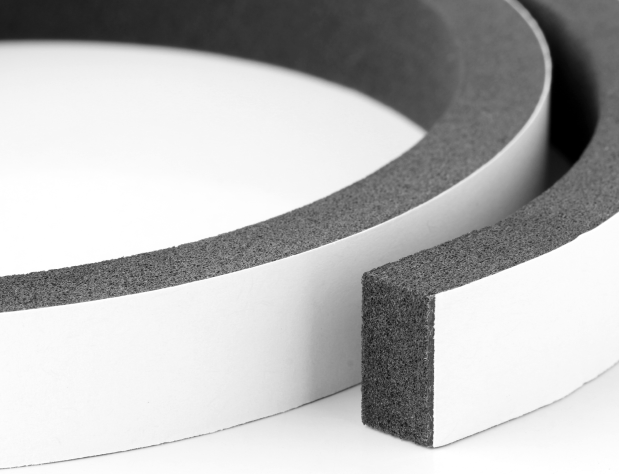
Why PSA and Foam Designs Fail in Manufacturing
Pressure sensitive adhesive (PSA) tapes and foam components are often selected based on lab-tested properties such as adhesion strength, temperature resistance, or compression set. Yet most failures do not occur in controlled testing, they occur in production.
Design for manufacturability (DFM) for pressure sensitive adhesives (PSA) foam parts is the process of engineering adhesive systems so they can be consistently converted, applied, and perform under real production conditions without introducing variability, downtime, or long-term failure modes.
PSA systems behave as viscoelastic, process-dependent materials, meaning performance is driven not only by adhesive chemistry, but by how the part is converted, handled, and applied in production.
When these variables are not engineered together, predictable failure modes emerge. Inconsistent placement, liner removal issues, adhesive contamination, and long-term degradation such as creep under sustained shear (ASTM D3654) can stop production in its tracks. In sealing applications, improper foam compression or thickness mismatch can create leak paths. During converting, adhesive flow can lead to edge ooze, while poor nesting or geometry can increase scrap rates.
In high-volume manufacturing, these failures scale rapidly into measurable business impact:
Line stoppages of 5–15 minutes per event in automated systems
Yield loss of 2–10% from misapplied or contaminated parts
Warranty risk from delayed adhesive creep or seal failure in field conditions
What Failure Looks Like in Production
Manufacturing failures are measurable and compound quickly at scale.
A seemingly small inefficiency, such as an extra 3 seconds required to remove a liner, can translate into over 400 additional labor hours annually at 500,000 units. Scrap rates driven by inefficient die cutting layouts or handling challenges can range from 5% to 20%, particularly with premium materials like acrylic foam tapes.
In automated environments, liner pre-release or inconsistent roll geometry can create downtime events that disrupt entire production lines. In sealing or bonding applications, undetected design issues can lead to field failures, rework, or warranty claims.
For engineers, this means that DFM is not a secondary consideration, but rather a critical design constraint.
DFM for PSA and Foam System Engineering
Design for manufacturability ensures that adhesive and foam components can be converted efficiently, applied consistently, and perform reliably in real-world conditions.
Flexible materials introduce inherent variability. Foam die cutting tolerances are typically ±0.03 in (±0.75 mm), and thicker materials (>0.125 in / 3.2 mm) increase variation due to compression and tool interaction. Adhesive system, particularly acrylic PSAs, require time to achieve full bond strength, often reaching >90% after 72 hours.
A converter plays a critical role in aligning these variables into a manufacturable format, ensuring that material performance translates into production reliability.
Adhesive Failure Modes in Manufacturing (ASTM-Based Root Causes)
Most adhesive failures in production can be traced to a small set of repeatable mechanisms:
Cohesive failure: internal adhesive breakdown under sustained shear stress, often linked to creep behavior (ASTM D3654)
Adhesive failure: poor wet-out on low surface energy substrates such as polypropylene (<36 dynes/cm) require specialized adhesive formulations for low surface energy bonding.
Edge ooze and contamination: adhesive flow during slitting or storage leading to handling issues
Liner pre-release: imbalance between liner release force and roll tension causing premature separation
These failure modes are rarely caused by material selection alone, but by misalignment between adhesive chemistry, converting process, and application method
Define the Application Before Selecting a PSA
One of the most common mistakes in adhesive design is selecting a PSA before fully defining the application.
Effective selection starts with five factors:
Function. Is the component intended for bonding, sealing, insulation, vibration damping, or surface protection?
Substrate. High surface energy materials like metals and glass bond readily, while low surface energy plastics such as polypropylene (<36 dynes/cm) require specialized adhesive formulations.
Load type. Shear loads behave differently from peel forces, and dynamic environments introduce fatigue and creep mechanisms.
Environment. Acrylic PSAs typically perform from –40°F to 250°F (–40°C to 121°C), rubber-based adhesives up to ~180°F (82°C), and silicone systems up to 500°F (260°C). Thermal cycling introduces coefficient of thermal expansion (CTE) mismatch, which can fatigue adhesive bonds over time.
Foam materials must be selected based on structure (open vs closed cell) and environmental resistance. Closed-cell foams provide moisture resistance and dimensional stability, while EPDM foams offer strong outdoor durability and UV resistance. Improper selection can lead to compression set, seal degradation, or premature failure
Assembly method. Whether a component is applied manually or through automation directly impacts adhesive selection, liner design, and part format.
In manual assembly, operators rely on initial tack and easy liner removal to maintain speed and consistency. Adhesives with fast wet-out, such as rubber-based PSAs, can reduce dwell time but may sacrifice long-term durability.
In automated systems, consistency becomes the primary constraint. Parts must feed reliably, release cleanly, and maintain positional accuracy. This requires controlled liner release, consistent roll geometry, and adhesives that balance tack with process stability to prevent pre-release or misalignment.
PSA systems provide uniform stress distribution, sealing, and vibration damping, while mechanical fasteners offer immediate load capacity and reworkability. In manufacturing environments, PSA systems reduce assembly steps but are more sensitive to surface preparation and process variation.
Material Selection: Performance vs Convertibility
Material selection must balance functional performance with convertibility.
From a performance standpoint, acrylic adhesives offer long-term stability but require bond build time. Rubber adhesives provide immediate adhesion but degrade under heat and UV exposure. Silicone systems perform in extreme environments but increase cost and processing complexity.
From a design standpoint, several quantitative thresholds should be considered:
Creep risk increases significantly when loads exceed ~50% of adhesive shear capacity (ASTM D3654 reference)
Compression set above 25–30% (ASTM D1056) can lead to long-term seal failure
Liner release values must balance processing and assembly.
Foam selection introduces additional considerations. Closed-cell foams provide sealing and moisture resistance, while open-cell foams enable airflow and vibration damping. Compression set, typically measured using ASTM D1056, directly affects long-term sealing performance and commonly ranges from 5% to 30%.
However, many designs fail not because of material limitations, but because the material cannot be processed effectively. Thick or highly compressible foams are more difficult to die cut cleanly. Adhesives may flow during slitting or storage, causing edge ooze. Liner systems must be engineered to balance secure hold during processing with clean release during application.
If convertibility is not considered early, designs that perform well in validation often fail during production.
Geometry and Liner Design: Where Most Issues Begin
Geometry is one of the most overlooked drivers of manufacturability.
Minimum feature sizes should generally not fall below 0.020 in (0.5 mm) for standard steel rule die cutting. Smaller features often require precision milled dies or laser cutting, which increases cost but improves precision to approximately ±0.005 in (±0.127 mm). Sharp internal corners should be avoided, as they create stress concentrations and reduce tool life; radii should typically match or exceed material thickness.
Liner design is equally critical. Features such as 0.25–0.50 in (6–12 mm) pull tabs can significantly improve assembly speed, while differential release liners help ensure proper orientation and reliable handling in automated systems.
These decisions directly affect labor time, assembly consistency, and overall production efficiency.
Selecting the Right Converting Process
The converting process must align with material behavior, geometry, and production volume.
Rotary die cutting is best suited for high-volume applications with smaller parts, offering repeatability and cost efficiency. Flatbed die cutting supports larger parts and moderate volumes. Laser cutting enables high precision for complex geometries, while knife cutting supports larger formats with lower precision. Waterjet cutting is often used for thick or highly compressible materials where deformation must be minimized.
Converting processes function as primary controls for preventing failure, not just fabrication steps:
Slitting controls edge quality and prevents adhesive contamination and edge ooze
Lamination ensures consistent bond thickness and multi-layer stability across the part
Die cutting defines geometry tolerances that directly impact placement accuracy and sealing performance
When integrated into a single workflow, these processes reduce handling, lower scrap rates, and improve production consistency.
Designing for Assembly Efficiency and Automation
The most measurable gains from DFM are realized at the assembly stage.
Well-designed adhesive components can reduce installation time by 20% to 50% while improving consistency and reducing operator variability. Pre-cut, tabbed parts eliminate secondary operations and simplify handling.
For automated systems, consistent roll geometry, controlled liner release, and precise part spacing are essential to avoid feeding errors and downtime.
At scale, even minor inefficiencies become significant cost drivers, making assembly-focused design a critical component of manufacturability.
Validation and Testing
No adhesive or foam design is complete without validation under real-world conditions.
Standard test methods include ASTM D3330 for peel adhesion, ASTM D3654 for shear strength, and ASTM D1056 for foam compression properties. Environmental durability should be evaluated through thermal cycling, UV exposure, and salt spray testing such as ASTM B117.
Rapid prototyping using laser or knife cutting allows engineers to validate fit, function, and assembly compatibility before committing to production tooling, reducing both risk and development time.
Case Example: Improving Manufacturability Through Design
A manufacturer previously relied on liquid adhesive to bond metal washers, resulting in long cure times, inconsistent application, and high labor cost.
By redesigning the solution as a die-cut closed-cell acrylic foam tape supplied kiss cut on a roll format with easily removable liner tabs, the assembly process was simplified and standardized.
The result was a 25% reduction in material cost, elimination of a dedicated work cell, and improved sealing performance with greater repeatability. Overall part throughput increased by over 45%.
DFM Checklist for PSA and Foam Components
Before finalizing a design, engineers should confirm:
Application requirements, substrates, and load conditions are clearly defined
PSA chemistry aligns with environmental exposure
Geometry supports efficient converting
Liner design enables fast, consistent assembly
Converting process matches production volume and complexity
Performance is validated using appropriate ASTM test methods
Most manufacturability challenges are resolved through integrated converting processes such as lamination, slitting, die cutting, and optimized roll formats. Early collaboration with a converter ensures these variables are engineered into the design from the start.
Engineering Material Solutions
Successful design for manufacturability (DFM) adhesive systems are not defined by material selection alone, but by system-level engineering across materials, converting, and assembly
When manufacturability is addressed early in the design process, engineers can reduce cost, improve throughput, and ensure consistent long-term performance.
Engineered Materials supports this process through material expertise, rapid prototyping, and advanced converting capabilities including lamination, slitting, die cutting, laser cutting, and waterjet cutting.
Contact Engineered Materials to evaluate your application and design for manufacturability from the start.