
Closed Cell Foam Insulation for Data Center Cooling: Armaflex vs K-Flex vs Aeroflex Comparison
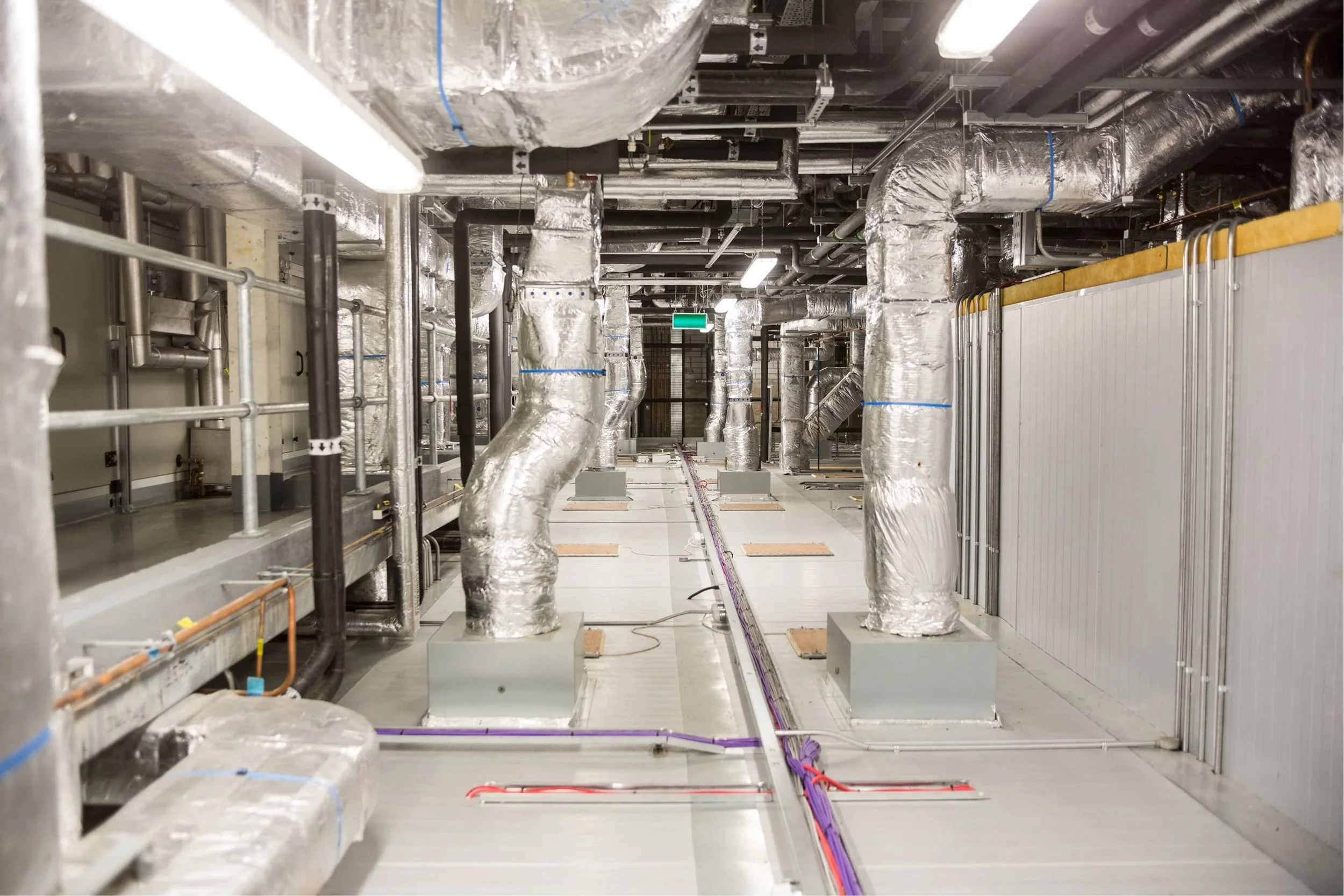
Why Insulation Failure in Data Center Cooling Leads to Condensation, Corrosion, and System Risk
In data center cooling systems , insulation failure is not primarily a thermal problem—it is a moisture control failure. Chilled water lines routinely operate below ambient dew point, meaning any discontinuity in the vapor barrier allows moisture to condense on pipe surfaces.
Vapor barrier failure occurs when water vapor penetrates insulation through seams, joints, or material degradation, allowing condensation to form on surfaces below the dew point. This is a system-level failure driven by installation quality, seam integrity, and long-term material stability rather than the base insulation material alone.
Once condensation begins, failure progresses quickly. Moisture accumulation leads to corrosion under insulation (CUI), microbial growth, degradation of adjacent components, and reduced thermal efficiency. In high-density data centers, even small increases in cooling load can negatively impact Power Usage Effectiveness (PUE), increasing operational costs. Visible symptoms such as dripping pipes or saturated insulation typically indicate late-stage failure.
For engineers, the critical insight is clear: insulation performance is governed by vapor barrier continuity, not just R-value.
What Is NBR/PVC Closed Cell Foam Insulation
Closed cell elastomeric insulation used in HVAC and data center cooling is typically based on Nitrile Butadiene Rubber (NBR) blended with Polyvinyl Chloride (PVC). This structure creates a flexible, closed-cell matrix that resists water vapor transmission while maintaining consistent thermal insulation.
Because the cells are fully enclosed, NBR/PVC foam functions as an integrated vapor barrier, eliminating the need for external jacketing in many indoor applications. Its flexibility allows it to conform tightly to pipes, valves, and irregular geometries, which is essential for maintaining continuous coverage.
Most products from Armaflex, K-Flex, and Aeroflex, the most common producers of vinyl nitrile foams, meet ASTM C534, which defines physical and thermal performance requirements for elastomeric insulation. While EPDM-based foams offer advantages in UV and high-temperature environments, NBR/PVC remains the preferred material for indoor chilled water systems due to its low permeability and cost efficiency.
Fire and Smoke Requirements for Data Center Insulation
Fire performance is a baseline requirement for insulation installed in plenums and near electrical infrastructure.
Elastomeric insulation must typically meet ASTM E84 Class 1 requirements:
· Flame Spread Index ≤ 25
· Smoke Developed Index ≤ 50
NFPA 90A governs the use of insulation materials in air-handling systems and requires that installed systems—including adhesives and seam treatments—maintain compliance.
Even when insulation meets fire standards, improper adhesives or sealing methods can compromise system compliance.
Key Performance Properties That Control Condensation
Thermal conductivity, water vapor permeability, and long-term material stability determine insulation performance in data center environments.
Thermal conductivity typically ranges from 0.033–0.040 W/m·K (0.23–0.28 BTU·in/hr·ft²·°F) and defines the thickness required to maintain surface temperatures above dew point.
Water vapor permeability is the most critical property for condensation control. High-performance NBR/PVC insulation achieves ≤ 0.10 perm-in per ASTM E96. Lower permeability reduces long-term moisture ingress risk.
These materials operate across a wide temperature range from –297°F to 220°F (–183°C to 104°C), covering all HVAC and chilled water conditions.
Flexibility allows the insulation to maintain contact at seams and joints but compression set over time can create micro-gaps that become primary pathways for vapor intrusion.
Dew Point-Driven Insulation Thickness Selection
Condensation prevention depends on maintaining the insulation surface temperature above the ambient dew point. This is determined through heat transfer modeling, not rule-of-thumb thickness selection.
ASTM C680 provides the framework for calculating required insulation thickness based on:
· Ambient temperature
· Relative humidity
· Pipe temperature
· Material thermal conductivity
For example, at 80°F (27°C) and 60% relative humidity, the dew point is approximately 65°F (18°C). A chilled water pipe operating at 42°F (5.5°C) must be insulated sufficiently to keep the outer surface above 65°F.
If insulation thickness is undersized by as little as 0.25–0.50 inches (6–12 mm), the surface temperature can fall below dew point, initiating condensation even when high-performance materials are used.
Armaflex vs K-Flex vs Aeroflex Insulation Comparison
Armaflex, K-Flex, and Aeroflex are all based on NBR/PVC elastomeric foam and meet ASTM C534 requirements. Their baseline performance is similar, and all are suitable for chilled water and HVAC applications when properly installed.
Property comparison:
Thermal conductivity: All three typically fall within 0.033–0.040 W/m·K
Water vapor permeability: Generally ≤ 0.10 perm-in
Fire performance: ASTM E84 Class 1 compliant
Key differences are primarily related to manufacturing consistency, product range, and cost positioning.
Armaflex, produced by Armacell, is widely regarded for consistent quality and a broad product portfolio, often at a premium price.
K-Flex offers comparable performance with strong availability and competitive pricing, though product variation can occur across different lines.
Aeroflex is typically selected for cost-sensitive applications and provides adequate performance for standard HVAC systems, with a narrower product range.
Performance differences between these brands are typically within 5–10% across key properties. In practice, system performance is dominated by installation quality, seam sealing, and system design rather than brand selection.
Where Insulation Systems Fail
Regardless of the manufacturer, insulation systems fail at discontinuities where the vapor barrier is interrupted. Common failure points include butt joints, elbows, valves, flanges, pipe supports, and instrumentation penetrations.
These locations create micro-gaps that allow water vapor to infiltrate and condense on cold surfaces.
Failure typically follows a predictable progression. Micro-gaps allow vapor ingress, leading to condensation at the pipe surface. Over time, this results in corrosion under insulation, increased thermal conductivity, and reduced system efficiency. Visible failure often occurs only after significant degradation has already taken place.
Moisture intrusion can increase effective thermal conductivity by 20–50%, significantly reducing insulation performance. Small efficiency losses can increase cooling demand and impact data center operating costs.
Adhesive Compatibility and Seam Integrity
The long-term performance of insulation systems depends heavily on adhesive systems and seam integrity.
Adhesives must maintain peel strength, resist creep under thermal cycling, and remain stable across HVAC operating temperatures. Typical performance targets include peel adhesion of 2–4 lb/in (0.35–0.70 N/mm) and temperature resistance up to 180–220°F (82–104°C).
Common failure modes include adhesive embrittlement, plasticizer migration, and edge lift caused by thermal expansion mismatch.
Because seams are the most vulnerable points in the system, engineered sealing solutions are critical for maintaining a continuous vapor barrier.
Foam Tape, Laminations, and Die-Cut Solutions for Vapor Sealing
To address seam and geometry challenges, engineers increasingly use converted insulation components rather than relying solely on bulk tubing.
Pressure-sensitive adhesive foam tapes can seal joints and transitions, maintaining vapor barrier continuity. Die-cut gaskets provide precise sealing around valves, flanges, and complex geometries where standard insulation cannot conform effectively.
Multi-layer laminations combining foam with foil facings or specialized adhesives can further enhance vapor resistance and mechanical durability.
At Engineered Materials, capabilities such as die-cutting, multi-layer lamination, slitting, and toolless cutting enable the production of application-specific insulation components that improve installation consistency and long-term performance. These solutions reduce field variability and address the most common sources of insulation failure.
Application Engineering Considerations
Effective insulation design requires a system-level approach that accounts for environmental conditions, materials, geometry, and installation methods.
High humidity environments increase condensation risk. Substrate materials such as steel and copper influence heat transfer behavior. Complex geometries require supplemental sealing strategies. Manual installation introduces variability that can compromise performance.
Thickness selection must always be based on dew point calculations rather than standard assumptions.
How to Select Insulation for Data Center Cooling
· If condensation is the primary concern, prioritize low permeability and continuous vapor sealing.
· If the system includes complex geometries, specify die-cut components and supplemental sealing methods.
· If installation variability is a risk, use pre-laminated or converted insulation assemblies.
· If the application requires long service life in high humidity conditions, focus on adhesive durability and compression set resistance.
Testing and Validation Standards
Engineers should specify ASTM C534 for material compliance, ASTM E96 for vapor permeability, ASTM C518 for thermal conductivity, and ASTM E84 for fire performance.
Verification through testing is essential in mission-critical environments such as data centers.
How to Prevent Condensation on Chilled Water Pipes
· Calculate dew point and required insulation thickness using ASTM C680 methods.
· Select closed cell insulation with permeability ≤ 0.10 perm-in.
· Maintain a continuous vapor barrier across all seams and penetrations.
· Use adhesive systems compatible with HVAC operating conditions.
· Seal all joints with PSA foam tape or equivalent vapor barrier solutions.
· Validate installation quality, as most failures originate from seam discontinuities.
Why Material Selection Alone Doesn’t Prevent Failure
Armaflex, K-Flex, and Aeroflex all provide insulation materials capable of meeting baseline performance requirements. However, material selection alone does not determine system success.
Long-term performance depends on maintaining a continuous vapor barrier across the entire system, including seams, joints, and penetrations. Engineers who focus only on insulation material without addressing installation and sealing strategies risk premature failure.
By combining appropriate materials with engineered converting solutions such as foam tapes, die-cut gaskets, and laminated barriers, insulation systems can achieve reliable long-term performance in data center environments.
Closed cell foam insulation for data center cooling must be engineered as a complete vapor barrier system, not just a material selection
FAQ: Elastomeric Insulation in Data Centers
What causes condensation on insulated pipes?
Condensation occurs when surface temperature falls below the ambient dew point, typically due to insufficient insulation thickness or vapor barrier failure.
Is Armaflex better than K-Flex or Aeroflex?
Performance differences are typically within 5–10 percent. Installation quality and vapor sealing have a greater impact than brand selection.
What is the most important insulation property?
Water vapor permeability, as defined by ASTM E96, is the most critical factor in long-term condensation control.
Contact Engineered Materials today to request a quote or talk about your application needs.