
Fire Barriers and Thermal Shields: How Ceramic Fiber Papers and High-Temperature Laminates Improve System Safety
Thermal protection in enclosed systems fail at the extremes. When insulation cannot survive the operating temperature, heat migrates into adjacent components, parts lose integrity, and fire resistance margins erode - often before any visible sign of failure appears.
The pattern appears across industries. An appliance oven insulation part loses integrity at operating temperature. An HVAC heat exchanger runs without adequate insulation at the flue interface. An industrial enclosure allows radiant heat to reach adjacent components. Each failure has the same root cause: the insulation material was not specified for the environment it was placed in.
The solution is a class of non-combustible refractory materials - ceramic fiber papers, alkaline earth silicate (AES) papers, fiberglass papers, and needled mats - that provide passive thermal protection and fire resistance in assemblies where polymer foams cannot survive. Each addresses a different temperature range and performance requirement. All four are available as precision-converted insulation solutions: die-cut parts, slit rolls, or laminated assemblies with pressure-sensitive adhesive (PSA) backing for direct installation or shielding layers leveraging metalized foils and glass cloths.
When Standard Insulation Is Not Enough
Foam rubber insulation is appropriate for applications below 225°F (107°C). EPDM foams can handle application up to 250 F (add C) and ECH foams can handling operation temperatures up to 325 F ( add C) Silicone Sponge extend the range to approximately 450°F (232°C) depending on grade. For applications that fall within the silicone range, the choice between silicone foam and silicone sponge affects compression, sealing, and temperature performance.
Above these thresholds, non-combustible refractory materials are required to provide passive thermal protection and industrial insulation where polymer-based materials cannot survive high temperatures. Here’s a broader overview of how thermal insulation materials are selected across temperature ranges and application environments.
High-volume applications that exceed silicone foam temperature limits include appliance ovens, boilers, fireplaces, and industrial refractory production where fire resistance and thermal management are required. In these environments, the insulation material must survive sustained high-temperature exposure without off-gassing, shrinking, or losing structural integrity.
Thermal performance must be evaluated beyond temperature rating alone. Thermal conductivity (k-value) governs heat transfer in high heat flux environments. Ceramic fiber papers typically range from 0.05–0.15 W/m·K at elevated temperatures, while fiberglass papers range from 0.03–0.08 W/m·K depending on density and temperature. Standard test methods include ASTM C177 and ASTM C518 for steady-state heat flow.
Thermal conductivity, k-value, and heat flux are just part of the evaluation. Here’s what to look for in a thermal insulation material.
Ceramic Fiber Papers
Ceramic fiber papers are lightweight refractory nonwoven sheets made from high temperature fibers processed from alumina-silica. Felt variants are available for applications requiring conformability to irregular surfaces. Non-combustible; provides high-temperature thermal insulation and shielding in enclosed systems.
· Operating temperature: 2300°F (1260°C) and above
· Melting point: typically above 3200°F (1760°C)
· Aerospace approvals: BMS9-19 and AMS 3680 Rev C
Paper brands include Lydall Lytherm, Unifrax Fiberfrax, and Morgan Advanced Materials Kaowool. Felt brands include Unifrax Fiberfrax, Lo-Con, Duraset, Morgan Advanced Materials Cerafelt, and K-Shield.
Applications:
· Appliance oven insulation
· Automotive muffler insulation
· Aerospace heat shields
· Wood-burning stoves
Ceramic fiber papers function as flame and thermal barriers in enclosed assemblies where sustained radiant heat exposure would degrade polymer-based insulation.
Alkaline Earth Silicate (AES) Papers
Alkaline earth silicate papers are thin, flexible, non-combustible refractory insulation solutions. Non-wetting to molten aluminum and immune to thermal shock - a key advantage in applications where rapid temperature cycling is a failure mode for conventional insulation materials.
· Operating temperature: 1830°F to 2100°F (999°C to 1149°C) depending on grade
· Low bio-persistent fiber compliant with EU Directive 97/69/EC and EC/1272/2008
· Where bio-persistence compliance is required and temperatures remain below 2100°F (1149°C), AES paper is the correct specification; above that range, ceramic fiber is specified
Product brands include Unifrax Insulfrax, Morgan Advanced Materials Superwool, and Lytherm LBP.
Applications:
· Automotive and aerospace heatshields
· Gaskets for ovens, stoves, and heaters
· Muffler insulation
Thermal Fiberglass Papers
Thermal fiberglass papers are thin, flexible industrial insulation sheets produced from non-respirable glass fiber. They provide outstanding thermal insulation at high temperatures and can withstand intermittent operating temperatures to 1200°F (649°C), with a continuous operating temperature of 1100°F (593°C) and above. Fiberglass papers serve as an alternative to silicone or ceramic fiber insulating and gasketing materials in applications that fall within their temperature range.
Fiberglass papers offer excellent dimensional stability, tensile strength in both machine and cross directions, low Loss on Ignition (LOI) to satisfy low smoke and odor requirements. Meets UL 94 V-0. Non-formaldehyde-based binders are used throughout. Available in white or black in standard sheet and roll formats; can be precision die-cut or slit. Brand: Lydall Manniglas (grades 1200, 1900, 2000).
Applications:
· Hearth products
· Furnace and boiler insulation
· Automotive heat shields
· Gasketing for lighting
Needled Mats
High temperature needled insulation mats are produced by mechanically entangling high temperature fibers without chemical binders. They are asbestos-free and serve as low-cost replacements for asbestos mats, ceramic fiber papers, and refractory fiber papers. Three fiber types are available, each covering a distinct temperature range.
E Glass
Most common option; excellent dimensional stability and resistance to chemicals, humidity, and high temperatures.
· Operating temperature: below 1200°F (649°C)
· Melting point: above 1520°F (827°C)
· Certifications: MIL-1-16411, ASTM-C-1086-96, Coast Guard specification #164.009, MIL-I-24244
Basalt
Most environmentally friendly option for manufacturing and recycling.
· Operating temperature: below 1380°F (749°C)
· Melting point: above 2640°F (1449°C)
Silica
Highest temperature resistance in the needled mat lineup; non-irritating, non-respirable; ceramic-free flame and thermal barrier for demanding environments.
· Operating temperature: below 1800°F (982°C)
· Melting point: above 3000°F (1649°C)
Product brands include Lydall Capriton, Excelfrax, Temp-Mat, and Lewco. Applications include industrial furnace insulation, oven insulation, engine insulation, acoustic insulation, and electrical insulation.
Foil Composites and High-Temperature Laminates
Plain refractory papers and mats provide thermal insulation through fiber-based heat resistance. Adding a foil layer introduces radiant heat reflection, and adding a PSA layer enables direct bonding to the assembly surface - converting a passive insulation solution into an integrated, installable component.
Engineered Materials’ multi-layer lamination capability produces constructions up to 60-inch web widths. Typical high-temperature laminate constructions include ceramic fiber paper, AES, fiberglass paper, or needled mat combined with aluminum foil and acrylic or silicone PSA for thermal protection to over 2300°F (1260°C); high-temperature fabric combined with silicone PSA for continuous service to 500°F (260°C); and aluminum foil tape constructions for heat shielding across a range of temperature requirements.
Adhesive selection within laminate constructions is determined by the service temperature at the bond line, which drives thermal management decisions at the component level. Acrylic PSA systems are appropriate to approximately 300°F (149°C) continuous. Silicone PSA systems - including Engineered Materials 8802 - are rated to 500°F (260°C). High-temperature foil tapes such as 3M™ 433 and 433L are rated to 600°F (316°C) and carry FAR 25.853(a) compliance for aerospace fire resistance requirements.
Laminated constructions allow passive flame and thermal barriers to be integrated into a single precision-converted component, replacing multi-step installation sequences involving separate insulation blankets, foil facings, and mechanical fasteners.
Material Selection Guide
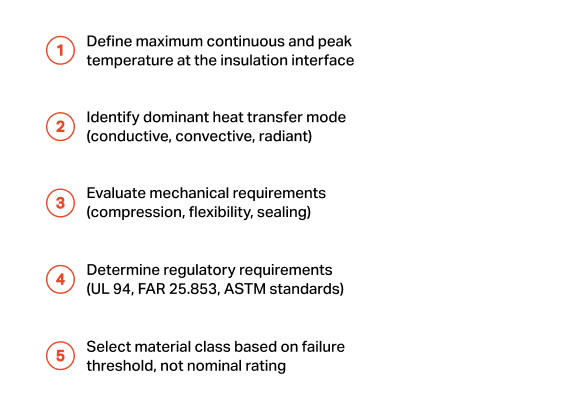
Selecting the right industrial insulation material starts with operating temperature, but temperature alone does not determine the correct specification.
· Below 225°F (107°C): foam rubber insulation
· 225°F to 450°F (107°C to 232°C): silicone foam
· Above 450°F (232°C): thermal fiberglass papers and needled mats, with fiber type selection based on target temperature
· 1830°F to 2100°F (999°C to 1149°C): AES paper
· Above 2100°F (1149°C): ceramic fiber paper or felt
· European bio-persistence compliance required: AES paper
· Irregular surfaces: felt variant
· Precise flat geometry and tight tolerances: paper form
Converting and Formats
All materials are available in the following formats:
· Die-cut parts
· Slit rolls
· Sheets
· Tabbed liners for peel-and-apply assembly on production lines
Waterjet cutting is preferred for thick or dense materials. For production volumes on thinner materials, flatbed and rotary die cutting are available. Multi-layer lamination up to 60-inch web widths enables large-format insulation solutions for transportation, HVAC, and aerospace applications.
FAQ
What is the difference between ceramic fiber paper and AES paper?
Both are non-combustible refractory insulation materials suitable for high temperature environments. The primary differences are operating temperature ceiling and fiber bio-persistence. Ceramic fiber paper is rated to 2300°F (1260°C) and above; AES paper operates to a maximum of 2100°F (1149°C). AES paper uses low bio-persistent fiber that complies with EU Directive 97/69/EC and EC/1272/2008 - a regulatory requirement for some European applications that ceramic fiber does not meet. Where temperatures remain below 2100°F (1149°C) and bio-persistence compliance is required, AES is the correct specification. Above 2100°F (1149°C), ceramic fiber is required regardless of regulatory preference.
When should I specify a foil laminate instead of plain ceramic fiber paper?
Plain ceramic fiber paper provides thermal insulation through fiber resistance. A foil laminate adds radiant heat reflection, which meaningfully reduces heat transfer in assemblies where the primary heat transfer mode is radiation - such as appliance oven walls and exhaust heat shields. The laminate construction also integrates a PSA bonding layer, which eliminates secondary adhesives and simplifies installation. Specify a foil laminate when the assembly requires both insulation and reflective shielding, or when the installation process benefits from a peel-and-apply component rather than a separately bonded insulation blanket.
Can these materials be die-cut to tight tolerances?
Yes. Ceramic fiber papers and AES papers can be precision-converted using waterjet cutting for thick or complex geometries, and flatbed or rotary die cutting for production volumes on thinner constructions. PSA-laminated components hold tolerances down to plus or minus 0.005 inches. Tabbed liner formats are available to support peel-and-apply assembly on production lines for gasket seals and thermal barriers. For irregular or complex geometries, toolless knife or waterjet cutting enables prototype production without tooling investment.
Contact Engineered Materials to review your application.