
UHMW Tape Applications: Surface Protection, Impact, and Wear Reduction
Surface damage often occurs before products reach the customer. Scratches, coating damage, abrasion from fixture contact, and installation marks are common failure modes that erode finish quality and create costly rework. Ultra-high molecular weight polyethylene (UHMW) tape is used as a sacrificial protective surface at tooling contacts, fixture interfaces, and assembly points to absorb that damage before it reaches the component. Applied correctly, UHMW tape preserves component finish and surface condition from production through installation.
Why UHMW Tape Works for Durable Long Term Surface Protection
UHMW is a thermoplastic defined by exceptionally long polymer chains that give it a unique set of mechanical properties. Its abrasion resistance exceeds that of polytetrafluoroethylene (PTFE) in sliding and impact wear environments. The coefficient of friction of UHMW is low - exceeded only by PTFE - providing a dry slip plane without requiring lubrication. This matters in production environments where lubrication cannot be used because it would contaminate downstream assembly or finishing steps.
When the application demands a choice between them, the differences become decisive. Here’s a detailed comparison.
Key performance properties of UHMW tape:
· High abrasion resistance. UHMW tape demonstrates[GU1] no evidence of wear-through after Taber Abrasion at 1,000 cycles using a CS-10 wheel and 1,000 g load. In sliding applications where PTFE would wear through, UHMW continues to protect.
· High impact strength. UHMW carries one of the highest impact strength ratings of any thermoplastic. This is critical in high-cycle mechanical applications where components absorb repeated contact loads: pivot points, mechanical stops, and guide surfaces that experience impact rather than pure sliding wear.
· Low friction surface reduces wear. The low surface energy of UHMW means mating surfaces slide rather than stick and drag. This reduces the force required at assembly interfaces and helps control noise, vibration, and harshness (NVH) in finished products.
· Resistant to chemicals and moisture. UHMW resists a wide range of chemicals and has a low water vapor transmission rate (less than 0.50 g/100 in²/24 hrs). This makes it durable in industrial wash-down environments and applications with incidental chemical exposure.
· Service temperature: –30°F to 225°F (–34°C to 107°C). Above 225°F (107°C), evaluate PTFE tape instead.
Where UHMW Tape Protects Surfaces
Manufacturing
In a production environment, components frequently contact fixtures, guides, conveyors, and other surfaces that would damage a finished substrate. UHMW tape protects surfaces from tooling and fixture contact, and is used on conveyor guide rails, discharge chutes, and spray booth liners where a non-stick, abrasion-resistant surface is needed. Where lubrication cannot be used because it would contaminate downstream assembly or finishing steps, UHMW tape provides a dry slip plane without introducing contamination risk.
Installation
Panels, frames, and sliding components are susceptible to scratching during final positioning and handling. UHMW tape applied to leading edges and guide surfaces acts as a slip plane that allows parts to seat without dragging. In many assemblies, the tape is not removed after installation. It remains in place as a permanent wear surface, protecting the interface through the service life of the product.
Mating Interfaces and Interface Sealing
UHMW tape performs a distinct function at static or slow-moving mating interfaces. Applied at the contact point between two components, it functions as a rigid, low-friction slip-plane barrier that prevents rattle and surface damage at the interface.
Common applications include appliance door-to-cabinet contacts, HVAC panel and cabinet interfaces, and guide-rail contacts in commercial equipment. The tape creates a consistent gap and prevents direct metal-to-metal or coating-to-coating contact that would generate wear debris or audible rattle under vibration.
It is important to understand what UHMW tape is not in this context: it is not a compressible gasket. It does not deflect to fill gaps, does not provide an air or water seal, and does not accommodate significant mismatch in mating surface profiles. For applications requiring sealing against air, water, or particulate intrusion, a foam or rubber gasket is the correct choice. UHMW tape’s role at an interface is to protect the sealing surface from wear and contact damage, and it is often used in combination with a separate gasket material rather than as a replacement for one.
Adhesive and Thickness Considerations
Adhesive Chemistry
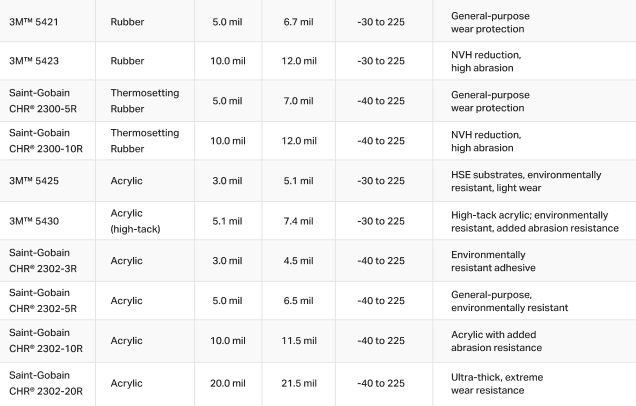
Rubber PSA provides high initial tack, making it well suited for manufacturing applications and temporary installation protection where the tape will be removed. Tradeoff: limited temperature ceiling and lower resistance to UV and long-term environmental exposure compared to acrylic. The Saint-Gobain CHR® 2300 series uses a thermosetting rubber adhesive - a crosslinked system that provides higher adhesion to steel (55 oz/in) and greater durability than standard rubber PSA.
Acrylic PSA provides better environmental resistance, superior weathering and aging characteristics, and stronger adhesion to metal substrates for longer-term in-service applications.
Thickness Selection
· Standard UHMW tapes in the 3 to 10 mil range are effective for light-to-moderate abrasion and NVH control, but they can fail prematurely in high-load, high-cycle mechanical environments. Failure typically presents as wear-through, edge deformation, adhesive shear failure, or substrate exposure, especially in applications involving repeated impact or concentrated contact loads.
What Changes with Thick UHMW (15 mil to 60 mil / 0.015" to 0.060")
Custom thick UHMW constructions transition the material from a protective film into a functional wear layer capable of absorbing both sliding and impact energy over extended service life.Key performance differences vs standard UHMW tape:
· Extended wear life
Increased thickness distributes contact stress across a larger material volume, delaying wear-through in high-cycle applications.
· Improved impact resistance
At thicknesses above 20 mil (0.020"), UHMW begins to absorb and dissipate impact energy rather than simply resisting abrasion.
· Load distribution
Thick UHMW acts as a semi-rigid bearing surface, reducing point loading that leads to coating damage or substrate deformation.
· NVH reduction (Noise, Vibration, and Harshness)
Additional material thickness dampens vibration at interfaces, particularly in appliance panels, HVAC enclosures, and transport equipment.
Thickness determines wear life and the magnitude of impact load the tape can absorb:
· 3 to 5 mil (3M™ 5421, 3M™ 5425, Saint-Gobain CHR® 2302-3R): light scratch protection where the primary risk is surface contact during handling or light sliding. Provides a slip plane without adding significant bulk to the assembly.
· 10 mil (3M™ 5423, Saint-Gobain CHR® 2302-10R): general-purpose choice for impact loading, NVH control, or moderate wear cycles. Added thickness extends wear life and attenuates vibration between contacting parts.
· 20 mil (Saint-Gobain CHR® 2302-20R, 21.5 mil total): extreme wear environments including high-cycle guide surfaces and heavy-load contact points where the tape functions as a long-term wear member.
· 20 to 62 mil, EMI heavy-wear UHMW: for the most demanding OEM wear applications. Engineered Materials fabricates its own thick UHMW tape with a high-performance LSE PSA that bonds reliably to polyethylene, polypropylene, powder-coated metals, and other difficult substrates where standard acrylic adhesives lose adhesion. Functions as a structural wear pad for heavy-use positioning and adjustment mechanisms.
FAQ
Can UHMW tape be used as a gasket?
No. UHMW tape is a rigid, non-compressible film that functions as a slip-plane interface or sacrificial wear surface. It does not compress to fill gaps, does not seal against air or water, and is not a substitute for foam or rubber gasketing materials. In applications where both surface protection and sealing are required, UHMW tape and a compressible gasket are used together: the tape protects the sealing surface from wear while the gasket provides the seal.
How does UHMW tape differ from standard polyethylene protective film?
Standard PE protective films are thin, temporary surface covers designed to prevent scratching during handling and transit to final assembly and to be peeled off before use. UHMW tape is an engineering material with permanent or semi-permanent PSA backing, abrasion resistance that exceeds PTFE in sliding applications, and high impact strength. UHMW tape is selected where the tape must function in service, absorbing wear cycles, reducing friction at interfaces, or controlling NVH - not simply as a peelable transit cover. For applications where ultra-low friction or chemical resistance outweighs impact strength, PTFE tape is the relevant alternative.
Is UHMW tape FDA compliant?
UHMW as a material is used in food contact and medical applications due to its chemical inertness and low extractables. However, FDA compliance for any specific tape construction must be verified against the manufacturer’s documentation for that product, as it depends on the adhesive system and any additives in the film formulation, not the UHMW backing alone. If FDA compliance is a requirement, confirm with the manufacturer before specifying.
Where Die-Cut UHMW Tape Is Used
Standard roll stock works well for conveyor liners, large panel protection, and bench-applied coverage. For assemblies with complex geometry or high-volume production requirements, die-cut parts deliver additional advantages:
· Precision fit to bonding surface eliminates overhang that can peel or trap contamination at edges.
· Kiss-cut liner format supports peel-and-apply installation on assembly lines without scissors or utility knives.
· Tabbed liner and pad formats available to match any assembly process.
· Anti-static black UHMW is available for ESD-sensitive environments.
· Black backing available upon request.
Engineered Materials converts UHMW tape using rotary die cutting for high-volume parts, flatbed die cutting for complex geometries and thicker constructions, and laser or knife cutting for toolless prototyping and short runs.
Application Checklist
Before specifying UHMW tape, confirm the following:
· Stage of protection. Manufacturing, installation, or in-service? Rubber PSA for temporary or short-cycle applications; acrylic or LSE acrylic PSA for permanent, long-term service.
· Environmental exposure and surface conditions. UV, moisture, chemicals, or wash-down exposure requires acrylic PSA. Rubber PSA is not suited for extended environmental exposure.
· Required wear resistance and tape thickness. Light scratch protection: 3 to 5 mil. Impact and NVH: 10 mil. Extreme wear: 20 mil. Structural wear pad for high-cycle OEM mechanisms: 20 to 62 mil with LSE PSA.
· Temperature. Does the application exceed 225°F (107°C)? If so, specify PTFE instead of UHMW.
· Format. Roll stock or die-cut parts? If die-cut, confirm whether tabbed liner, kiss-cut liner, or pad format best supports the assembly process.
Specifying UHMW Tape for Protection, Sealing, and Preservation
UHMW tape protects surfaces from abrasion and contact damage across manufacturing, installation, and in-service wear. The material properties of UHMW including abrasion resistance that exceeds PTFE in sliding environments, high impact strength, low friction, and long service life - make it a durable solution for the contact points and interfaces that degrade over the product lifecycle.
The right adhesive, right thickness, and right format preserve component quality from production through installation. Where temperatures exceed 225°F (107°C), PTFE is the correct specification. For the most demanding high-cycle wear applications, Engineered Materials’ own thick UHMW constructions (20 to 62 mil, with high-performance LSE PSA) extend service life further than standard catalog products can achieve.
Contact Engineered Materials to review your application.