
UHMW or PTFE? Choosing the Right Slick Surface Tape for Wear and Friction Control
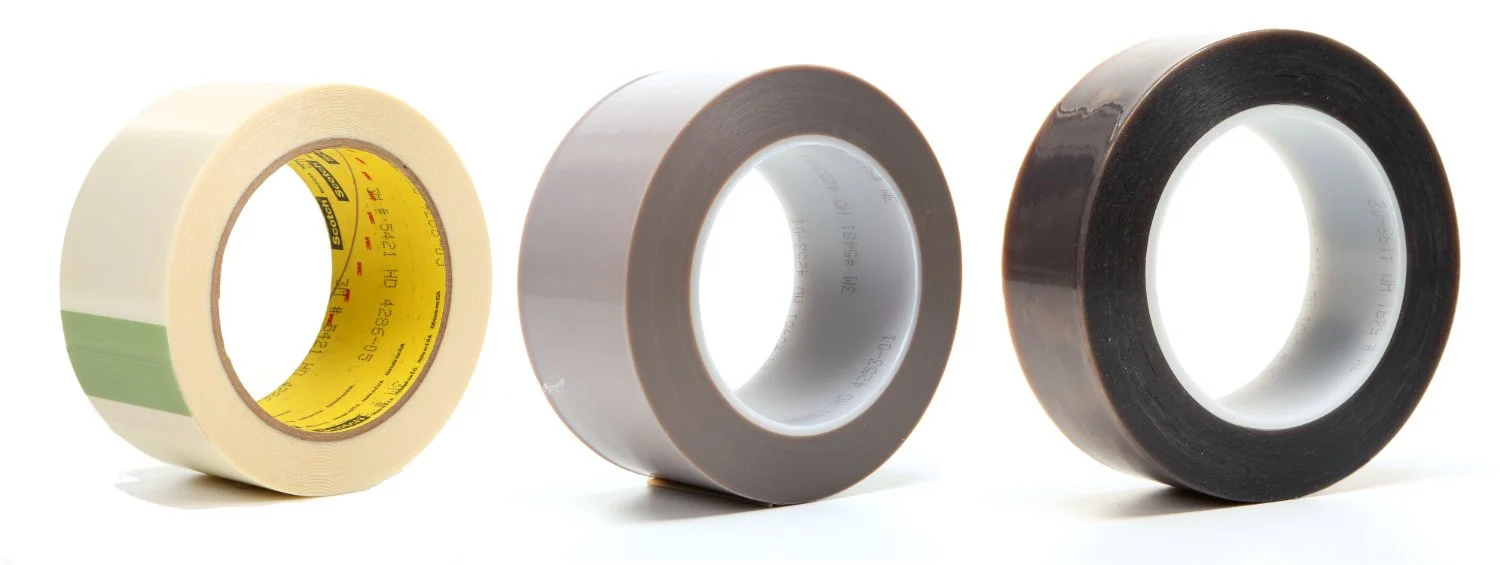
Managing Friction and Wear in Industrial Environments
Friction, abrasion, and wear are persistent challenges in industrial systems that involve repeated motion or surface contact. As components slide, impact, or cycle against one another, friction contributes to energy loss, reduced efficiency, impact wear, and gradual equipment degradation. Left unmanaged, these forces increase maintenance demands, shorten service life, and introduce unwanted noise into mechanical systems particularly in high-cycle equipment where micro-wear accumulates.
UHMW and PTFE pressure-sensitive tape constructions are commonly specified to address these challenges. By introducing low-friction, wear-resistant tape layers between contacting surfaces, manufacturers protect critical components, support noise reduction, and enable longer, more reliable operation across a wide range of industrial applications without the need to redesign the base components.
UHMW and PTFE Tape Material Characteristics
While both UHMW and PTFE tapes are used to reduce friction and wear, their material properties differ in ways that influence durability, operating temperature range, and application suitability. Understanding these differences helps engineers select the appropriate slick surface tape for demanding environments based on contact pressure, cycle rate, and environmental exposure.
UHMW Tape Performance in High-Wear Applications
Ultra-high-molecular-weight polyethylene (UHMW) is valued for its exceptional abrasion resistance, impact strength, and durability. UHMW tapes perform well in sliding, impact-prone, and high-cycle environments where repeated contact would otherwise damage equipment or components.
UHMW’s molecular structure, characterized by extremely long polymer chains, enables high impact strength and outstanding resistance to abrasive wear. Typical UHMW films exhibit a coefficient of friction in the range of ~0.10–0.22 (ASTM D1894) and impact resistance exceeding that of standard polyethylene grades.
These tapes are used in applications that demand effective wear control, durable performance, and reduced noise from repeated contact. Common applications include conveyor systems, chute liners, guide rails, cabinet drawer slides, and tank and bin liners where a slippery surface helps control friction between substrates.
UHMW tape constructions commonly used in wear-control applications include:
3M™ UHMW Film Tapes 5421 and 5423: general-purpose and high-abrasion tapes for sliding surfaces and high-contact zones, with thicker backing options supporting noise, vibration, and harshness (NVH) reduction by absorbing impact energy at contact points
3M™ UHMW Film Tapes 5425 and 5430: constructions with environmentally resistant acrylic adhesives, designed for applications exposed to moisture, contaminants, or extended service conditions
Saint-Gobain 2300-Series UHMW Tapes (2300-5R, 2300-10R): rubber-adhesive tapes providing general-purpose wear protection and enhanced abrasion resistance for material handling interfaces where long-term adhesive shear strength is required
Saint-Gobain 2302-Series UHMW Tapes (2302-3R, 2302-5R, 2302-10R, 2302-20R): acrylic-adhesive tapes available in multiple thicknesses, including ultra-thick constructions for extreme wear environments with sustained contact pressures
Across these constructions, UHMW tapes function as sacrificial wear layers. They absorb abrasion and impact while protecting the underlying substrate, extending component life, and reducing maintenance frequency while maintaining dimensional stability under repeated loading.
Design engineers should specify UHMW tape when abrasion, impact loading, or repeated contact dominates failure modes, particularly in material handling, conveyor systems, and sliding wear surfaces.
PTFE Tape Performance for Low-Friction and High-Temperature Conditions
Polytetrafluoroethylene (PTFE) is known for its ultra-low coefficient of friction, chemical inertness, and stability across a wide temperature range. PTFE tapes support smooth sliding, reduced drag, and consistent motion, particularly in applications where minimizing stick-slip behavior is critical.
PTFE typically exhibits a coefficient of friction as low as ~0.04–0.10 (ASTM D1894), making it one of the lowest-friction solid materials available for industrial use.
PTFE tapes are used in both electrical insulation and industrial slick-surface applications. Their non-stick properties, chemical resistance, and high-temperature capability make them well suited for environments where UHMW may reach its performance limits due to heat exposure or chemical attack.
PTFE tape constructions commonly used include:
3M™ PTFE Film Electrical Tapes 60, 61, and 63: PTFE-backed electrical insulation tapes offering varying thicknesses, dielectric strength, and adhesive systems for high-temperature and abrasion-resistant insulation applications (dielectric strength values exceeding 7,000 V/mil depending on construction)
3M™ PTFE Extruded Film Tapes 5490 and 5491: low-friction, non-stick PTFE tapes with silicone adhesive systems designed for high-temperature release surfaces and challenging substrates
Saint-Gobain CHR® 2045 and 2255 Series Tapes: PTFE constructions providing low friction, chemical resistance, electrical insulation, and durability in high-wear, high-temperature industrial environments
These PTFE constructions are commonly selected where smooth release, thermal stability, chemical resistance, or electrical insulation is required alongside wear resistance.
PTFE tape should be specified when ultra-low friction, non-stick release, chemical exposure, or elevated temperature performance is the primary design constraint.
Low Friction and Wear Resistance in High-Contact Applications
Reducing friction improves system efficiency and limits energy loss in moving assemblies. Wear-resistant surfaces extend equipment life, reduce maintenance frequency, and contribute to quieter operation. Both UHMW and PTFE tapes serve as buffer layers that protect application surfaces and mating components from direct contact.
Material selection depends on abrasion severity, friction requirements, environmental exposure, and operating temperature range. UHMW typically excels in high-abrasion, impact-prone environments, while PTFE is favored where ultra-low friction, non-stick properties, chemical resistance, or elevated temperature performance is required (continuous service temperatures up to ~500°F / 260°C for PTFE versus ~180–200°F / 82–93°C for UHMW).
UHMW vs. PTFE: Key Differences for Slick-Surface Applications
Although UHMW and PTFE tapes are often considered together, their performance characteristics differ in meaningful ways:
Abrasion vs. friction dominance: UHMW offers superior abrasion and impact resistance, while PTFE delivers a lower coefficient of friction
Temperature capability: PTFE maintains performance at higher operating temperatures
Chemical resistance: PTFE is more chemically inert
Typical use cases: UHMW is commonly selected for material handling and wear surfaces, while PTFE is used for non-stick, release, and high-temperature applications
Understanding these trade-offs helps engineers select the appropriate material for specific wear and friction challenges.
UHMW and PTFE Tapes in High-Wear Industrial Systems
Material Handling Systems
In material handling environments, UHMW and PTFE tapes are applied to:
Conveyor guides & wear strips
Chute liners & slide surfaces
Package transfer points
Accumulation areas
Tank and bin liners
These applications benefit from reduced friction, controlled noise, and extended component life. 3M™ UHMW Film Tape 5423 is often chosen for continuous contact zones requiring abrasion resistance, noise, vibration and harshness (NVH) reduction under repeated impact loading. and harshness (NVH) reduction under repeated impact loading
Sliding Interfaces and Contact Surfaces
Sliding interfaces often involve metal-to-metal or metal-to-plastic contact that generates friction and wear. UHMW and PTFE tapes are used on drawer slides, guides, rails, and repetitive motion assemblies to support smooth, consistent movement while protecting mating surfaces.
Industrial Equipment and Machinery
Industrial equipment relies on low-friction, wear-resistant surfaces for guarding, protective liners, and wear zones in packaging, processing, and automation systems. PTFE constructions such as Saint-Gobain CHR® 2045 Series Tape and CHR® 2255 Series Tape are often used where heat resistance, chemical exposure, or electrical insulation is required.
These materials are also applied in automotive bump, squeak, and rattle (NVH) applications and in areas where friction occurs between dissimilar substrates.
Key Performance Considerations When Selecting UHMW or PTFE Tape
Selecting between tapes involves evaluating:
Required coefficient of friction
Expected wear life under repeated cycling
Load and contact pressure
Environmental exposure, including temperature and chemicals
Adhesive selection and bond durability on the application surface including shear strength and creep resistance
UHMW and PTFE tapes are available with rubber or acrylic pressure sensitive tape systems to support a range of substrates and operating conditions in accordance with ASTM D3330 (peel) and ASTM D3654 (static shear) performance criteria.
Adhesive selection often governs long-term success more than the film itself. UHMW tapes typically bond best with high-tack rubber or acrylic PSAs, while PTFE’s low surface energy often requires silicone adhesives to maintain bond integrity at elevated temperatures. Both films may be corona treated, primed, or etched to raise surface energy in order to match adhesive performance requirements with the requirements of the application.
UHMW vs. PTFE Comparison Table
| Property | UHMW Tape | PTFE Tape |
|---|---|---|
| Coefficient of friction (ASTM D1894) | ~0.10-0.22 | ~0.04-0.10 |
| Continuous service temperature | ~180–200°F (82-93°C) | Up to ~500°F (260°C) |
| Abrasion resistance | Excellent | Moderate |
| Impact resistance | Excellent | Low |
| Chemical resistance | Good | Excellent |
| Typical adhesive systems | Rubber / Acrylic PSA | Silicone / Acrylic PSA |
| Typical use priority | Wear & impact | Friction & heat |
Prototyping and validation—using ASTM D1894 (friction), ASTM D3330 (peel adhesion), and in-application wear testing—helps confirm material selection before production release.
Converting UHMW & PTFE Tapes for Application Fit
Material performance alone does not determine success. Precision converting ensures UHMW and PTFE tapes perform as intended once integrated into assemblies.
Precision Cutting and Formatting: die cutting supports repeatable shapes and tight tolerances, while knife and digital cutting methods are used for prototyping and large-format components
Slitting and Sheeting: custom slitting and sheeting provide application-specific widths and lengths with clean edges that support consistent installation
Lamination and Assembly: UHMW and PTFE tapes can be laminated with pressure-sensitive adhesives and converted into application-ready parts that simplify installation and alignment while reducing assembly labor and variability
Industries That Rely on UHMW & PTFE Tapes
Manufacturing and automation systems use UHMW and PTFE tapes for high-cycle motion components and equipment protection. Material handling and logistics operations apply these materials to reduce friction and noise. Packaging and processing equipment relies on slick surfaces to support smoother operation and reduce product damage.
Selecting the Right Slick-Surface Tape for Your Application
Choosing the appropriate tape involves matching material properties to friction, wear, and motion requirements. Evaluating cycle rate, service conditions, installation method, and surface preparation supports informed material selection. Prototyping and performance validation help confirm suitability before full-scale production.
Where UHMW & PTFE Tapes Deliver Lasting Performance
UHMW and PTFE tapes play a critical role in managing friction, abrasion, and wear across high-contact industrial systems. Proper material selection, combined with precision converting, supports reliable performance, reduced maintenance, and long-term durability.
Connect with Engineered Materials to discuss UHMW and PTFE tape solutions tailored to your equipment, application surfaces, and performance requirements.